
Disclosure: this article contains no affiliate links. All links are plain links, and we earn nothing if you click them. See our affiliate disclosure.
How this was made: researched and drafted with AI tools from the sources linked in this article, then checked against those sources before publishing.
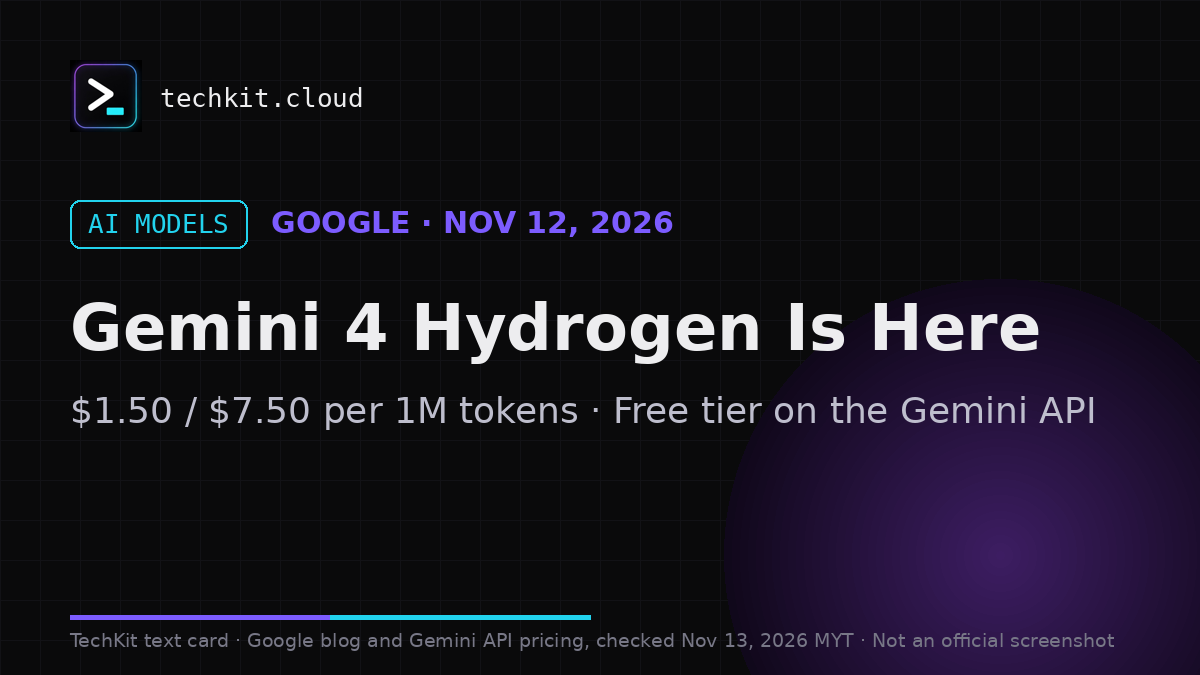
Quick answer: Google released Gemini 4 Hydrogen on November 12, 2026 (U.S. time; 2 a.m. November 13 in Malaysia), a Gemini 4 model built for speed and efficiency in everyday coding and agentic work. On the paid Gemini API it costs $1.50 per million input tokens and $7.50 per million output tokens, flat across its 1 million-token context window, and Google’s pricing page also lists a free tier. Google says Hydrogen beats Gemini 4 Argon on the Artificial Analysis Intelligence Index at its default thinking level (51 vs. 50).
What Google launched
In Google’s announcement, Koray Kavukcuoglu writes that the frontier models, Gemini 4 Carbon and Gemini 4 Argon, “excel at deep, long-horizon reasoning on your hardest problems,” while “Hydrogen is built for rapid execution across diverse agentic workflows.” The model card says Hydrogen is adapted from Gemini 4 Carbon and lists a knowledge cutoff of March 2026.
Against Gemini 3.8 Flash, Google says Hydrogen finishes tasks 2.5 times faster at its high default setting, scores 57% on Terminal-Bench 4.1 (vs. 18.2%) and cuts fabricated claims by more than 5x.
What it costs
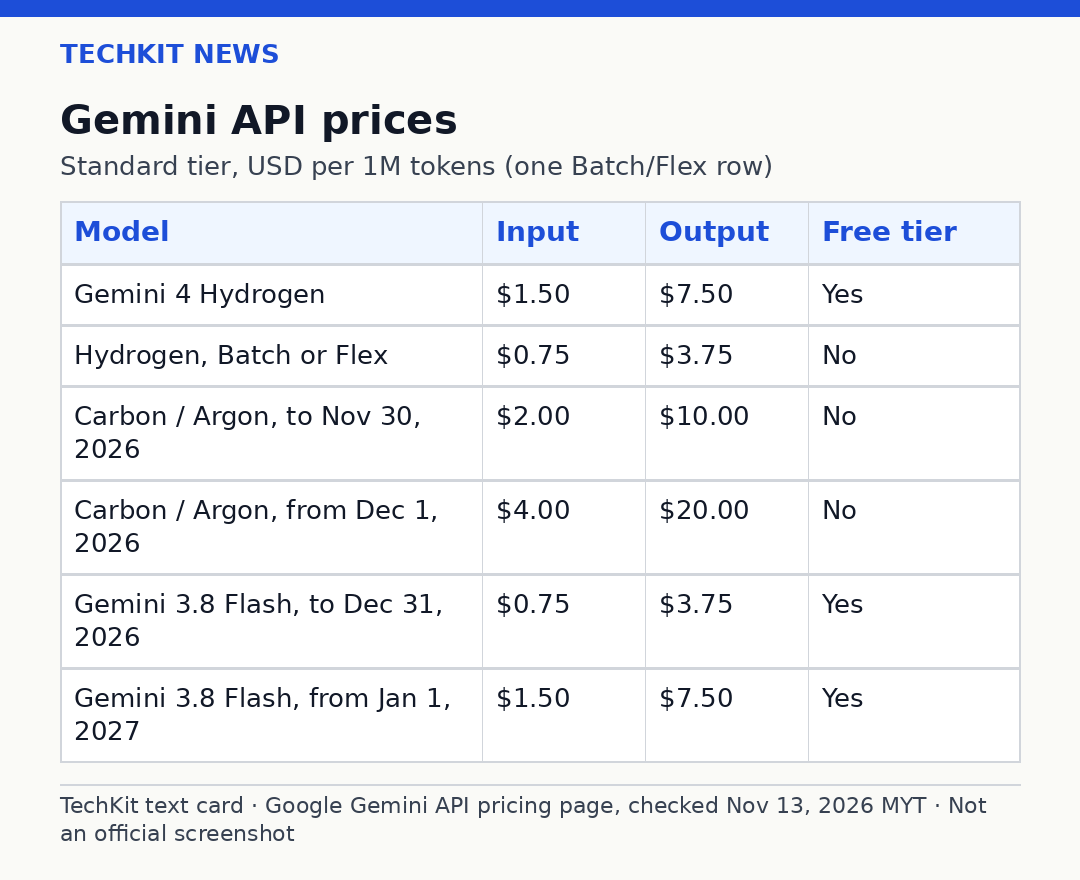
Google’s Gemini API pricing page (checked 02:59 MYT, November 13, 2026) lists Hydrogen’s paid Standard tier at $1.50 per 1M input tokens and $7.50 per 1M output tokens, with thinking tokens counted as output. Batch and Flex requests cost $0.75 input and $3.75 output. The free tier lists input and output as “Free of charge”, but the same table marks free-tier data as used to improve Google’s products; paid-tier data is marked “No”.
On the same page, Gemini 4 Carbon and Gemini 4 Argon each cost $2.00 input and $10.00 output through November 30, 2026, then $4.00 and $20.00 starting December 1, 2026, and neither is available on the free tier. Gemini 3.8 Flash costs $0.75 and $3.75 through December 31, 2026, then $1.50 and $7.50 starting January 1, 2027. Our November 11 post covers Gemini 4 Carbon pricing in detail.
Who gets it, and where
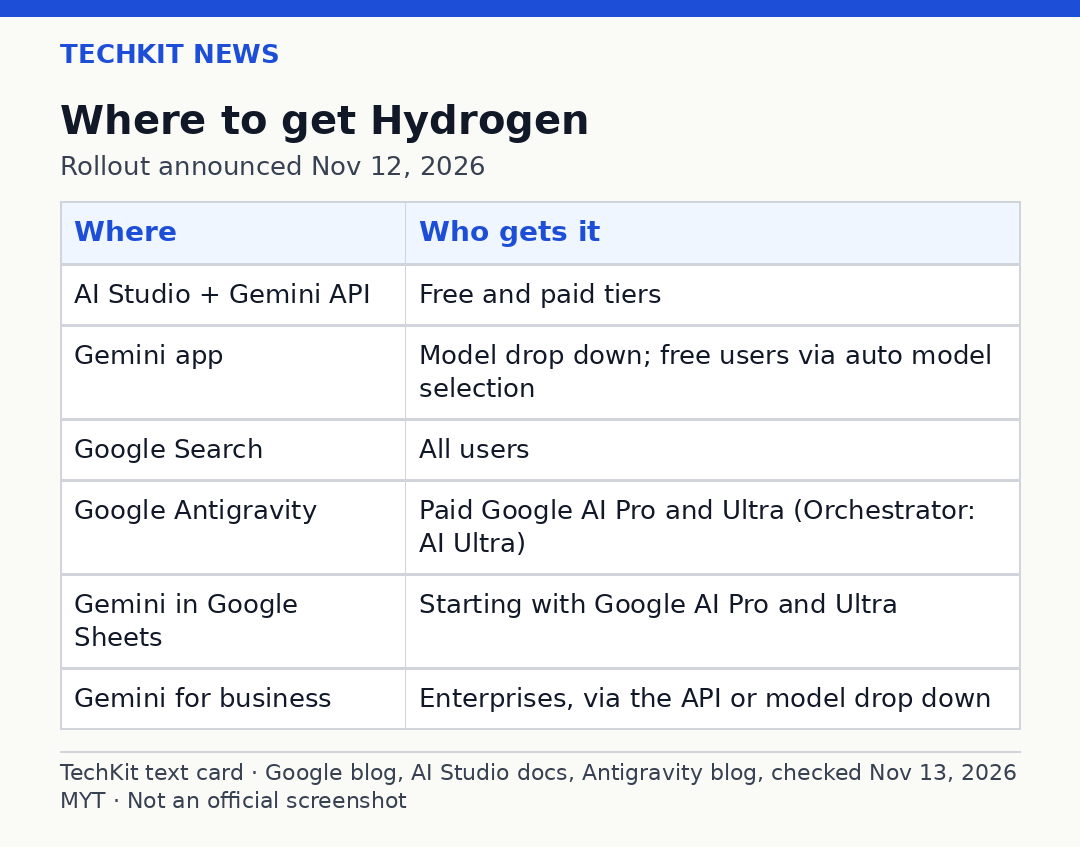
Google says Hydrogen is rolling out globally starting November 12:
- Developers: all tiers of Google AI Studio and the Gemini API. Google’s AI Studio docs say it is on both the free and paid tiers.
- Gemini app: in the model drop down. A footnote in the blog says free users get Hydrogen “via auto model selection when it’s the appropriate model for the prompt.”
- Google Search: for all users.
- Google Antigravity: paid Google AI Pro and Ultra subscribers.
- Gemini in Google Sheets: starting with Google AI Pro and Ultra subscribers.
- Enterprises: Gemini for business via the API or model drop down, Google Antigravity, and Gemini in Google Sheets for eligible business subscriptions.
Cursor said on X that Hydrogen is now available in Cursor, scoring 54.3% on CursorBench at default effort, “up from 39.6% for Gemini 3.8 Flash.”
Hydrogen, Carbon or Argon?
Google’s AI Studio docs suggest Hydrogen for “everyday coding, interactive web apps, tool-using agents, multimodal document workflows, and parallel subagent execution.” They call it the “Recommended upgrade from Gemini 3.8 Flash and earlier Gemini 3 and 2.5 models.” Carbon is described as “Our strongest frontier model.” Argon is for “the majority of advanced long-horizon tasks with lower token use than Carbon.”
Hydrogen has four thinking levels: low, medium, high (the default) and a new xhigh. The docs warn that “Using xhigh increases latency and token use and can cause overthinking on simpler prompts.”
Google also launched Orchestrator in Antigravity, which switches between Carbon and Hydrogen within one session. Google says it reached near-Carbon task success rates while using 24% less quota on average and finishing 19% faster. Google’s main post cites Terminal-Bench 4.0 for that result; the Antigravity blog cites Terminal-Bench 4.1. The Antigravity blog says Orchestrator is rolling out for Google AI Ultra subscribers.
Limits to know
- The benchmark figures are as reported by Google and Cursor; we have not tested Hydrogen.
- Output length: the model card lists “up to 64K default synchronous output tokens / up to 1M via background long decode.”
- Refusals: the model card says unjustified refusals are higher than Gemini 3.8 Flash, “particularly for multimodal prompts.” Its full Safety & Security Report “will be available in the coming days.”
For more Google model news, see our posts on Gemini Decision 1 and the Gemini Omni 1.2 Flash price cut.
FAQ
How much does Gemini 4 Hydrogen cost?
On the paid Gemini API Standard tier, $1.50 per million input tokens and $7.50 per million output tokens, flat across the 1 million-token context window. Batch and Flex cost $0.75 and $3.75, per Google’s pricing page checked 02:59 MYT on November 13, 2026.
Can I use Gemini 4 Hydrogen for free?
Google’s pricing page lists a free tier for Hydrogen on the Gemini API, and free-tier data is used to improve Google’s products. In the Gemini app, free users get it via auto model selection when it is the appropriate model for the prompt. Google says it is in Google Search for all users.
Is Gemini 4 Hydrogen better than Gemini 4 Argon?
Google says Hydrogen scores 51 on the Artificial Analysis Intelligence Index at its default high thinking level, vs. 50 for Argon, and 54 at xhigh. Google still positions Carbon and Argon for deep, long-horizon reasoning on the hardest problems.
What is Gemini 4 Hydrogen’s context window?
A unified 1,048,576-token window shared by input, thinking and output tokens, per Google’s AI Studio docs. Synchronous responses go up to 65,536 tokens; Google says responses can run past 64K up to 1M tokens using background execution or client-side continuation.
What is Orchestrator in Google Antigravity?
A model option that switches between Gemini 4 Carbon and Hydrogen within one session. The Antigravity blog says it is rolling out for Google AI Ultra subscribers, and enterprises can access it in Gemini for business.
Sources
– Google, Koray Kavukcuoglu, “Introducing Gemini 4 Hydrogen” (November 12, 2026, 18:00 UTC / 02:00 MYT Nov 13): blog.google
– Google AI for Developers, Gemini API pricing (checked November 13, 2026 MYT): ai.google.dev
– Google AI Studio docs, “What’s new in Gemini 4 Hydrogen”: aistudio.google.com
– Google DeepMind, Gemini 4 Hydrogen model card (PDF, published November 2026): storage.googleapis.com
– The Antigravity Team, “Gemini 4 Hydrogen and Orchestrator” (November 12, 2026): antigravity.google
– Sundar Pichai on X (November 12, 2026, 18:02 UTC / 02:02 MYT Nov 13): x.com
– Google DeepMind on X (18:02 UTC / 02:02 MYT Nov 13): x.com; Logan Kilpatrick on X (18:05 UTC / 02:05 MYT): x.com
– Cursor on X (18:19 UTC / 02:19 MYT Nov 13): x.com
– Related: techkit.cloud, “Gemini 4 Carbon Pricing: $2/$10 Until Nov 30”: techkit.cloud
– Related: techkit.cloud, “Gemini Decision 1: Google’s Model That Picks, Not Writes”: techkit.cloud
– Related: techkit.cloud, “Gemini Omni 1.2 Flash Cuts Video Price 30%, Adds 15s”: techkit.cloud
1 thought on “Gemini 4 Hydrogen: $1.50/$7.50 API, Free Tier Included”