
This article contains no affiliate links. How this article was prepared: AI helped gather and draft this research; a person checked the facts against the cited sources.
Quick answer: F5 fixed two critical HTTP/2 flaws in NGINX on November 18, 2026. CVE-2026-123007 and CVE-2026-123633 both allow unauthenticated remote code execution and both score 9.2 under CVSS 4.0. The fix is NGINX Open Source 1.31.9 (mainline) or 1.30.7 (stable). If you cannot upgrade yet, disable HTTP/2. Xint said it had no evidence of exploitation in the wild when the flaws were disclosed, but Rapid7 has published a public proof of concept for CVE-2026-123007.
The two HTTP/2 flaws
CVE-2026-123007 is an integer underflow in HTTP/2 flow control. It affects NGINX Open Source 1.9.5 through 1.31.8, a range reaching back to 2015, and it works in default configurations with HTTP/2 enabled. Wiz demonstrated code execution on a server serving ordinary static files, with no backend application and no third party module. CVE-2026-123633 is a use-after-free in HTTP/2. It affects versions 1.19.7 through 1.31.8 and needs NGINX to proxy requests to a backend while a worker runs low on free connections. Both flaws need HTTP/2 enabled. Five research teams — Wiz Research, Ikotas Labs, Metnir, Rapid7 and Xint — found the two flaws independently and reported them to F5. Wiz says it used Gemini 4 Carbon and ChatGPT 5.6 Sol to validate both flaws (https://www.wiz.io/blog/nginx-http2-rce-vulnerabilities).
Five critical flaws, ten fixes
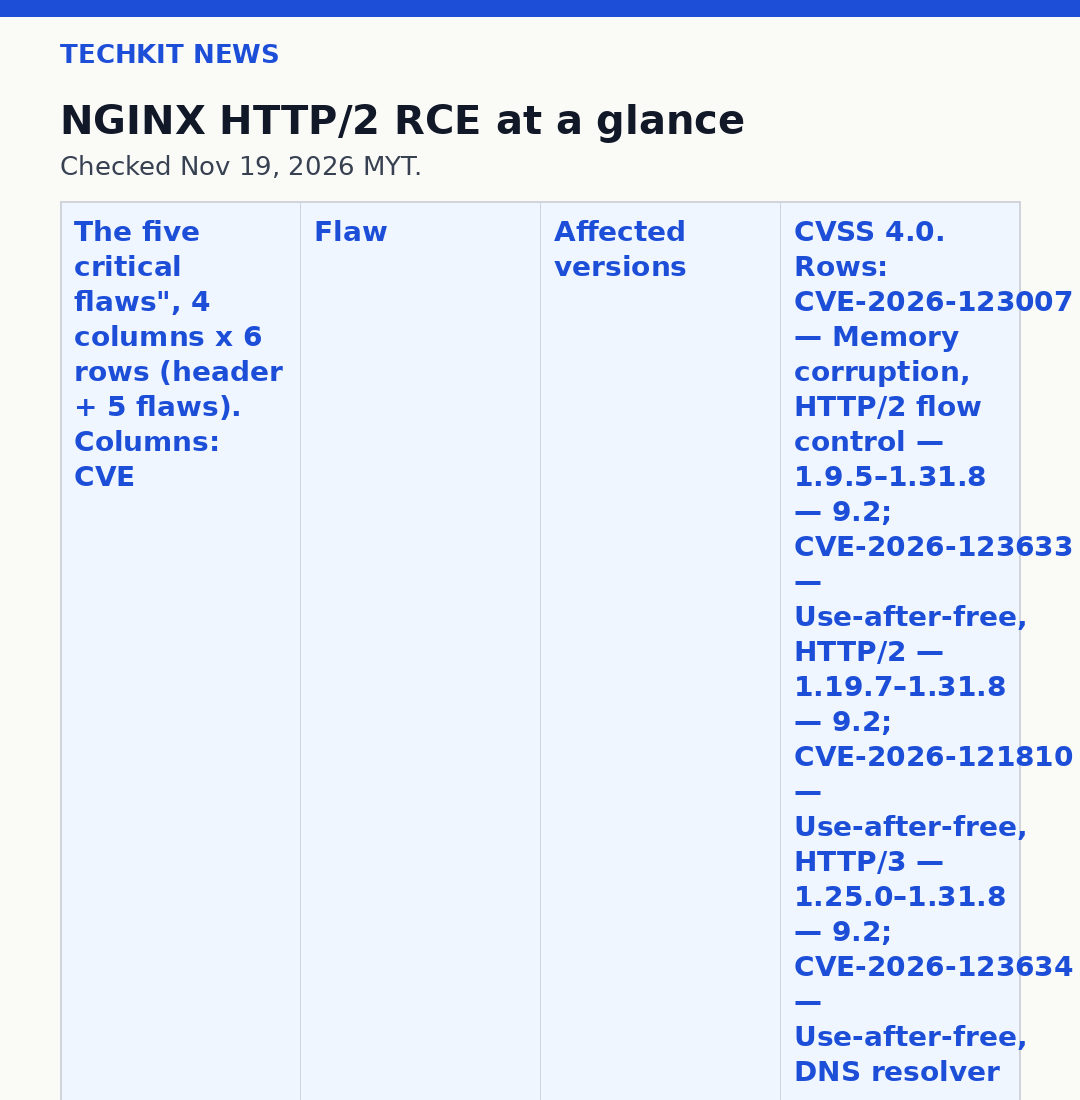
The November 18 release fixed ten flaws in total. Five are rated critical at 9.2 under CVSS 4.0: the two HTTP/2 flaws plus CVE-2026-121810 (a use-after-free in HTTP/3), CVE-2026-123634 (a use-after-free in the DNS resolver) and CVE-2026-113425 (a use-after-free in the mail proxy module). The same release fixed five more flaws: CVE-2026-118899 (8.7), CVE-2026-120993 (6.9), CVE-2026-125283 (6.9), CVE-2026-123640 (6.9) and CVE-2026-120967 (6.3). Ikotas Labs calls the two HTTP/2 flaws NGINX2Shell, while Xint calls the five-flaw set NGINX2Root. F5's advisories for the two HTTP/2 flaws are K000163926 (CVE-2026-123007) and K000163928 (CVE-2026-123633).
How hard is it to exploit?
CVE-2026-123007 is real but expensive to exploit. Rapid7 says reaching code execution needs approximately 128 GB of HTTP/2 data on one connection, and NGINX's default one-hour connection lifetime means a network slower than about 300 Mbit/s cannot finish in time. Rapid7's example took two and a half minutes: about two minutes on a 10 Gbit/s network, about seventeen on a 1 Gbit/s network (https://www.rapid7.com/blog/post/ve-cve-2026-123007-critical-nginx-http-2-integer-underflow-leads-to-rce-fixed/). CVE-2026-123633 is harder to reach: it needs NGINX to act as a proxy and a worker running low on free connections. Xint said it had no evidence of exploitation in the wild at the time of publication, though the age of some flaws means exploitation cannot be ruled out (https://www.infosecurity-magazine.com/news/five-critical-vulnerabilities/). Rapid7 has published a public proof of concept for CVE-2026-123007; Wiz has not published exploit code.
What to do now
Upgrade NGINX Open Source to 1.31.9 (mainline) or 1.30.7 (stable), and restart NGINX — a reload does not replace the running binary. NGINX Plus users should upgrade to 37.0.8.1 or 37.3.0.1 to fix both flaws; builds 37.0.7.1 and 37.2.0.1 fix only CVE-2026-123633. If you cannot upgrade yet, turn HTTP/2 off: on NGINX 1.25.1 or later, set http2 off, and on older versions remove http2 from the listen directive. Turning HTTP/2 off does not cover the other three critical flaws (CVE-2026-123634, CVE-2026-121810 and CVE-2026-113425), so upgrading is still needed.
FAQ
Which NGINX versions are affected?
CVE-2026-123007 affects 1.9.5 through 1.31.8, and CVE-2026-123633 affects 1.19.7 through 1.31.8. Both are fixed in 1.30.7 (stable) and 1.31.9 (mainline).
Is there a workaround if I cannot patch yet?
Yes: turn HTTP/2 off. On NGINX 1.25.1 or later, set http2 off; on older versions, remove http2 from the listen directive. The workaround does not cover the other three critical flaws, so upgrade soon.
Has anyone exploited these flaws in the wild?
Xint said it had no evidence of exploitation in the wild at the time of publication. Rapid7 has published a public proof of concept for CVE-2026-123007.
What is the difference between NGINX2Shell and NGINX2Root?
NGINX2Shell is the name Ikotas Labs uses for the two HTTP/2 flaws; NGINX2Root is the name Xint uses for all five critical flaws.
Do I need to restart NGINX after upgrading?
Yes. Install a fixed release and restart NGINX; a reload does not replace the running binary.
Sources
NGINX security advisories (official): https://nginx.org/en/security_advisories.html
Wiz Research: https://www.wiz.io/blog/nginx-http2-rce-vulnerabilities
Rapid7: https://www.rapid7.com/blog/post/ve-cve-2026-123007-critical-nginx-http-2-integer-underflow-leads-to-rce-fixed/
JFrog Security Research: https://research.jfrog.com/post/nginx2shell-all-you-need-to-know-about-cve-2026-123007-and-cve-2026-123633/
Infosecurity Magazine: https://www.infosecurity-magazine.com/news/five-critical-vulnerabilities/
nginx2shell.com (Ikotas Labs): https://nginx2shell.com/
IONIX: https://www.ionix.io/blog/critical-nginx-rce-cve-2026-123007-cve-2026-123633/
F5 advisory K000163926 (CVE-2026-123007): https://my.f5.com/manage/s/article/K000163926
F5 advisory K000163928 (CVE-2026-123633): https://my.f5.com/manage/s/article/K000163928