
this article contains no affiliate links. All links are plain links, and we earn nothing if you click them. See our affiliate disclosure. How this article was prepared: AI helped gather and draft this research; a person checked the facts against the cited sources.
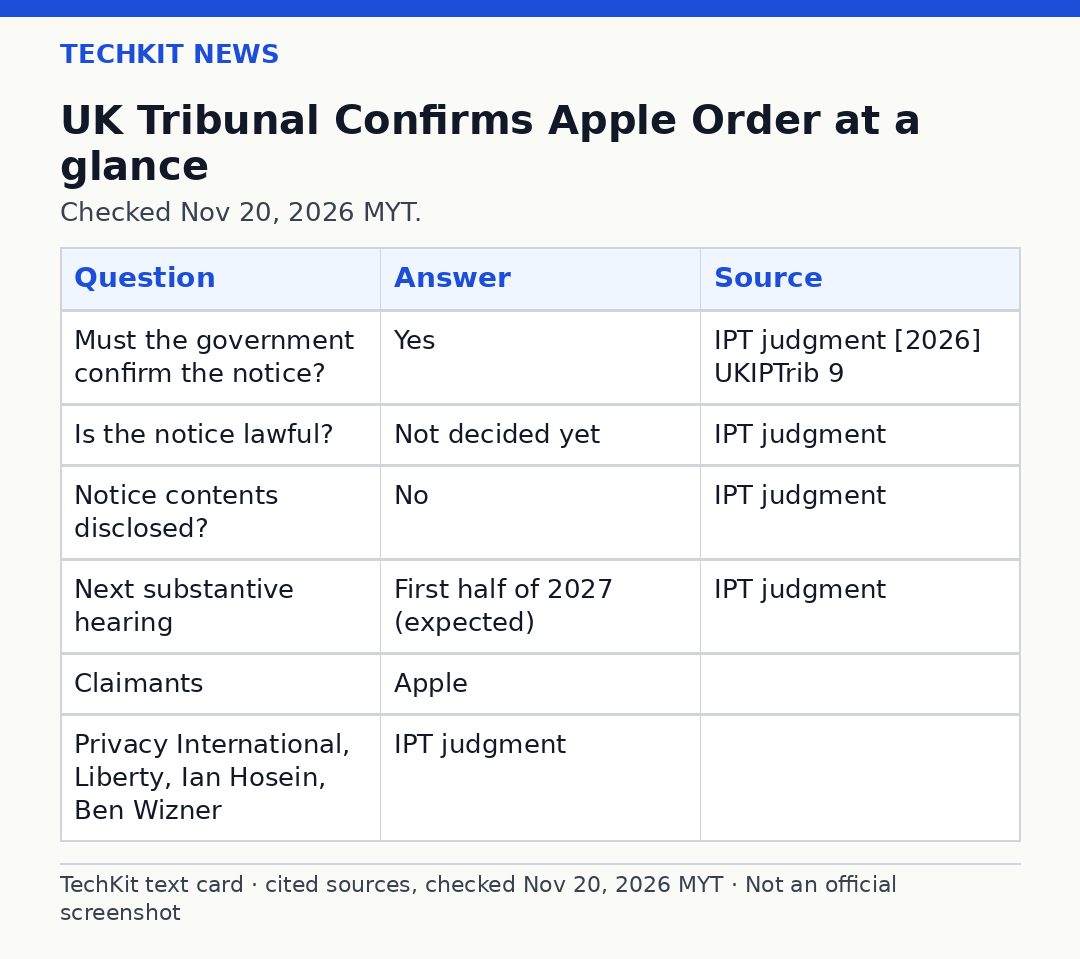
Quick answer: On November 19, 2026, the UK Investigatory Powers Tribunal ruled that the government must confirm it served Apple with a Technical Capability Notice (TCN) under section 253 of the Investigatory Powers Act 2016, rejecting the claim that confirming it would harm national security. It did not rule on whether the notice is lawful, nor disclose its contents. A substantive hearing is expected in the first half of 2027.
What the tribunal decided
After a hearing on September 17, 2026, three judges — Lady Carmichael, Mr Justice Chamberlain and Mr Justice Johnson — rejected the claim that confirming the notice would damage national security. The government had operated a policy of neither confirming nor denying such notices, but it had not applied that policy consistently: officials had confirmed the notice to journalists at The Times and the Financial Times, and to US officials, and the tribunal concluded those briefings were authorised. The amount of information already public meant confirming the order would do little, if any, damage. The tribunal also handed down private judgments that cannot be disclosed without damaging the public interest.
What it did not decide
The ruling does not make a finding about whether the notice is lawful. That question, and how much of the notice's detail can be aired, is left for later hearings. Apple has five grounds of challenge. The first two — whether the government has power to issue warrants for targeted interception of communications outside the United Kingdom, and whether the statutory power can regulate the security or privacy services offered by a technology company — are questions of statutory interpretation that do not depend on evidence, and can be determined entirely in open court.
Who brought the case
The judgment covers two joined claims: Apple Inc against the Secretary of State for the Home Department (case IPT/26/191/CH), and Privacy International, Liberty, Ian Hosein and Ben Wizner against the same respondent (case IPT/25/83-86/CH). Privacy International, Liberty and the two individuals are challenging the lawfulness and secrecy of the TCN regime. Apple's current challenge was filed in July 2026; its first challenge was dismissed after a change in circumstances, when the UK reportedly withdrew a notice in September 2025.
The background
At the core is Apple's Advanced Data Protection (ADP), which stores encryption keys on users' devices. Because Apple never holds the keys, it cannot access iCloud content even with a lawful request. It was widely reported in February 2025 that Apple received a notice requiring access to iCloud data protected by ADP. In February 2025, Apple withdrew ADP for British users entirely. In September 2025, the UK reportedly withdrew a TCN under US pressure. In October 2025, the Financial Times reported a second notice, understood to restrict its scope to the UK. Apple refused the order and blocked UK users from switching on ADP; the order was later narrowed to British nationals' data, which Apple also challenged.
What happens next
The parties agree a substantive hearing in December 2026 is impractical; they expect one in the first half of 2027. At that hearing the tribunal will decide whether the notice is lawful and how much of its detail can be disclosed. Apple told TechCrunch it welcomes the decision to make public the fact that the UK Home Office issued a technical capability notice. Apple has previously said it has never built a backdoor or master key to any of its products or services and never will. A Home Office spokesperson did not respond to TechCrunch's request for comment.
Quick questions
What did the tribunal decide?
The government must confirm it served Apple with a Technical Capability Notice.
What is a Technical Capability Notice?
An order under the Investigatory Powers Act 2016 requiring a company to keep access to users' data in readable form.
What did the tribunal NOT decide?
Whether the notice is lawful, and what details can be disclosed.
Why did Apple withdraw ADP in the UK?
Apple withdrew ADP for British users in February 2025 after receiving the notice, rather than comply.
Who brought the case?
Apple, and separately Privacy International, Liberty, Ian Hosein and Ben Wizner.
Sources
Investigatory Powers Tribunal (via Courts and Tribunals Judiciary): Apple Inc -v- Home Secretary and others, [2026] UKIPTrib 9 — https://www.judiciary.uk/judgments/apple-inc-v-home-secretary-and-others/ — November 19, 2026 (judgment PDF: https://www.judiciary.uk/wp-content/uploads/2026/11/OPEN-Judgment-Apple-Inc.-and-Privacy-Int.-Ors.pdf)
The Record: UK court confirms British government served Apple with secret encryption notice — https://therecord.media/apple-uk-encryption-notice — November 19, 2026
Privacy International: Win! Tribunal orders UK Government to come clean about secret order to Apple — https://privacyinternational.org/news-analysis/5896/win-tribunal-orders-uk-government-come-clean-about-secret-order-apple/ — November 19, 2026
TechCrunch: UK government forced to disclose secret Apple backdoor order — https://techcrunch.com/2026/11/19/u-k-government-forced-to-disclose-secret-apple-backdoor-order/ — November 19, 2026
Reuters (via Duke FM): UK tribunal confirms government order demanding access to Apple data — https://duke.fm/2026/11/19/uk-has-imposed-an-order-demanding-access-to-apple-data-uk-tribunal-says/ — November 19, 2026
Last checked: November 20, 2026, MYT.