
Disclosure: this article contains no affiliate links. All links are plain links, and we earn nothing if you click them. See our affiliate disclosure.
How this was made: researched and drafted with AI tools from the sources linked in this article, then checked against those sources before publishing.
Quick answer: AWS announced AWS Emulator on November 11, 2026: a local emulator of AWS that runs on a developer’s own machine. The AWS CLI, the AWS SDKs and coding agents talk to it over a local HTTPS endpoint using the same AWS APIs they use in the cloud. AWS says it is generally available and has no additional service fee.
What AWS Emulator is
AWS’s example is a unit test that creates a DynamoDB table, writes an item and reads it back: it is the same test, and it runs on your machine without a deployment.
AWS says the emulator has no additional service fee; you pay only for AWS resources when you deploy on AWS. Its source is on GitHub, and it is written in Rust so that it stays light on CPU and memory on a laptop. On Linux you install it from an RPM or Debian package. On macOS and Windows you build a Docker image from a short Dockerfile in the documentation; AWS says it does not publish a ready-made image. You can also build it from source.
How it works on your machine
When it starts, the emulator generates its own credentials, a config file and a certificate, according to AWS. You set environment variables so the AWS SDK talks to your laptop instead of AWS, and your application code stays unchanged.
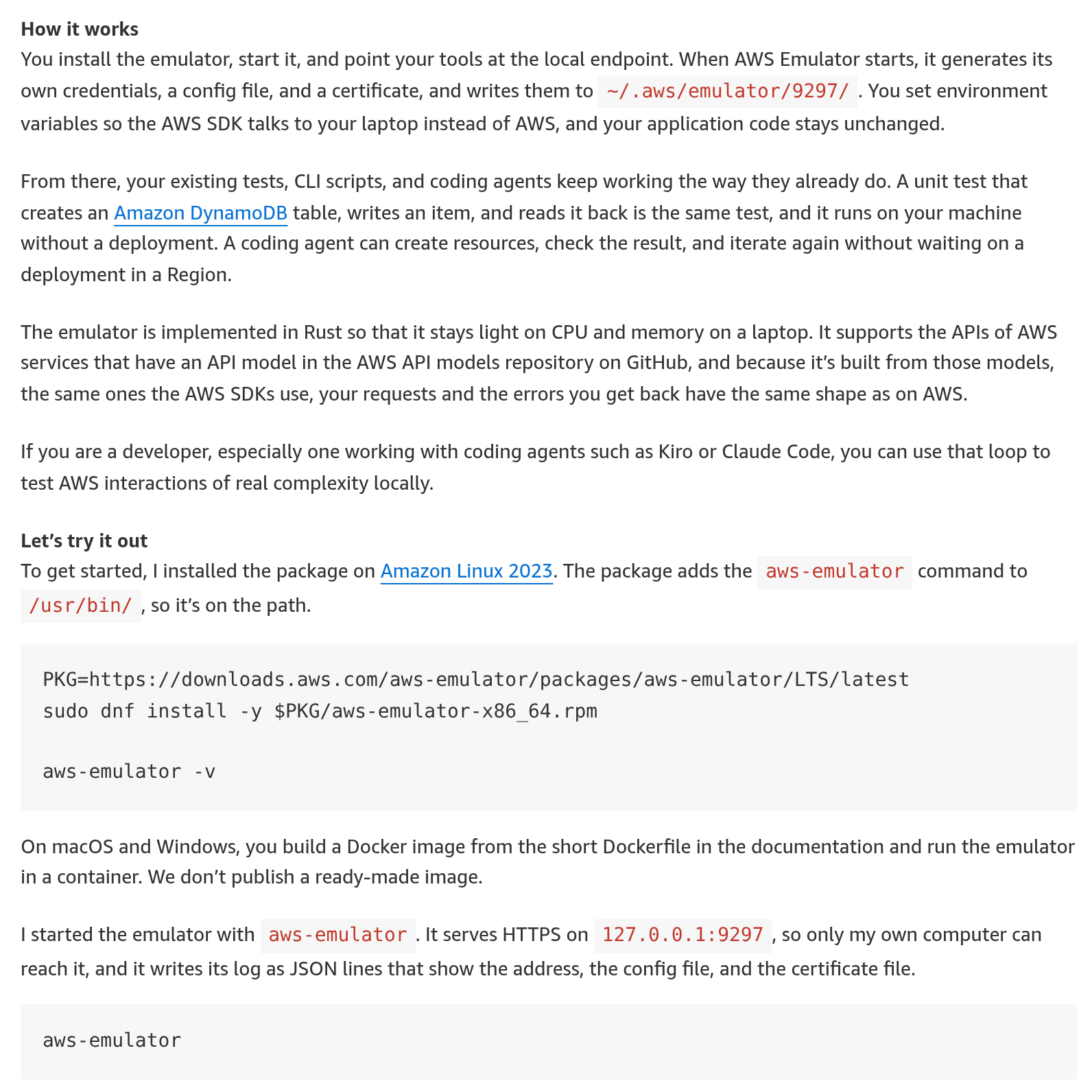
The emulator serves HTTPS on 127.0.0.1:9297, so only your own computer can reach it, AWS says. It uses a single account, 000000000000, generates new keys each time it starts, and its access key IDs begin with EMULATOR. By default it sends anonymous usage and error data, which you can turn off.
It supports the APIs of AWS services that have an API model in the AWS API models repository on GitHub. Because it is built from those models, your requests and the errors you get back have the same shape as on AWS, according to AWS. For tests, an embedded mode for the AWS SDK for Rust runs inside your test process instead of as a separate server.
Fidelity scores and the limits
AWS says it measures how closely the emulator matches AWS with fidelity tests: short programs that use an AWS SDK to run a workflow, such as storing an object and then reading and deleting it, and check how AWS behaves.
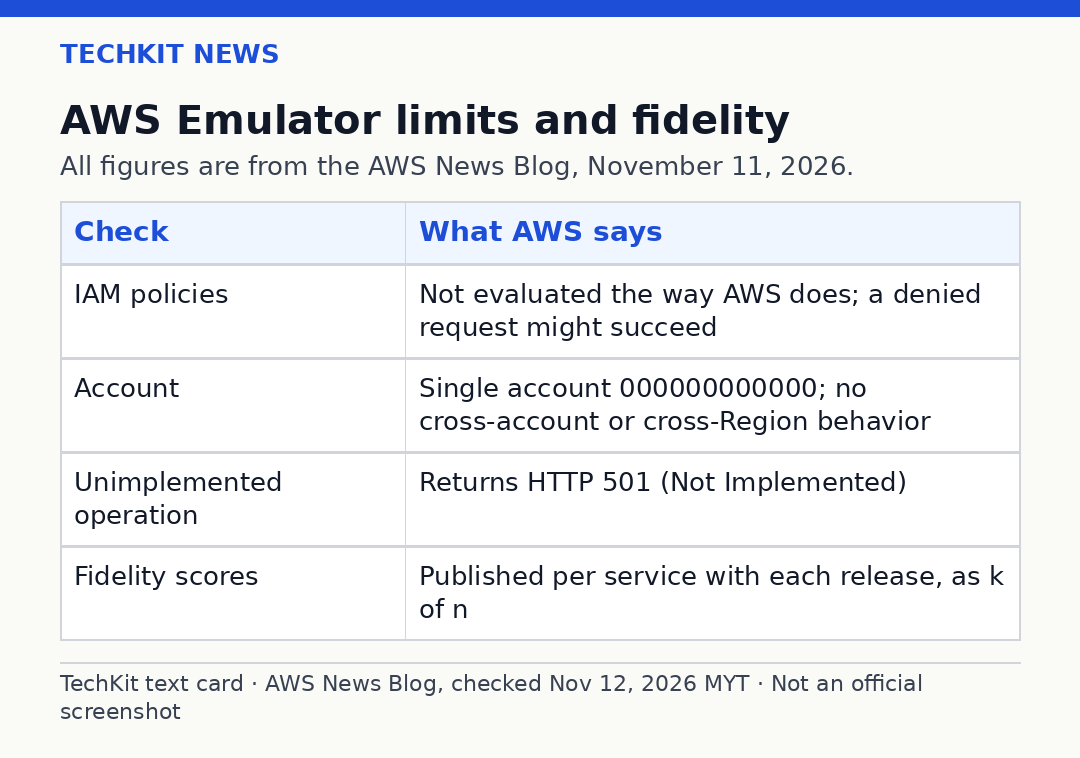
With each release, AWS publishes how many fidelity tests pass for each service, as k of n. For example, 40 of 50 means that 40 of the service’s 50 fidelity tests pass. The tests are public in the aws-emulator-evaluation-suite repository on GitHub, including the ones that do not pass yet. If the emulator does not implement an operation yet, it returns HTTP 501 (Not Implemented), so your tests fail right away.
AWS says the emulator does not evaluate IAM policies and resource-based policies the way AWS does, so a request that AWS denies might succeed in the emulator. Each emulator acts as a single account, with no cross-account or cross-Region behavior, and how closely it matches AWS varies by service and feature.
Built by agents, checked by agents
AWS says the emulator is built and maintained by agents from the AWS API models, using Amazon Bedrock AgentCore Runtime Instances, AWS CodePipeline and AWS CodeCommit. Because the code is written by agents, an independent security agent reviews changes adversarially, both while a fix is being made and again in the release pipeline, according to AWS.
Related on TechKit: AWS AgentCore Web Search API, November 10
Quick questions
How much does it cost?
AWS says it has no additional service fee. You pay only for AWS resources when you deploy on AWS.
How do I install it?
From an RPM or Debian package on Linux. On macOS and Windows you build a Docker image from the Dockerfile in the documentation, or you can build from source. It serves HTTPS on 127.0.0.1:9297.
Can I use it to test security?
No. AWS says not to use the emulator to test whether your application is secure, because it does not evaluate IAM policies and resource-based policies the way AWS does.
Sources
– AWS News Blog, “Test your applications against AWS locally with AWS Emulator”, by Daniel Abib, November 11, 2026: https://aws.amazon.com/blogs/aws/test-your-applications-against-aws-locally-with-aws-emulator/