
Disclosure: this article contains no affiliate links. All links are plain links, and we earn nothing if you click them. See our affiliate disclosure.
How this was made: researched and drafted with AI tools from the sources linked in this article, then checked against those sources before publishing.
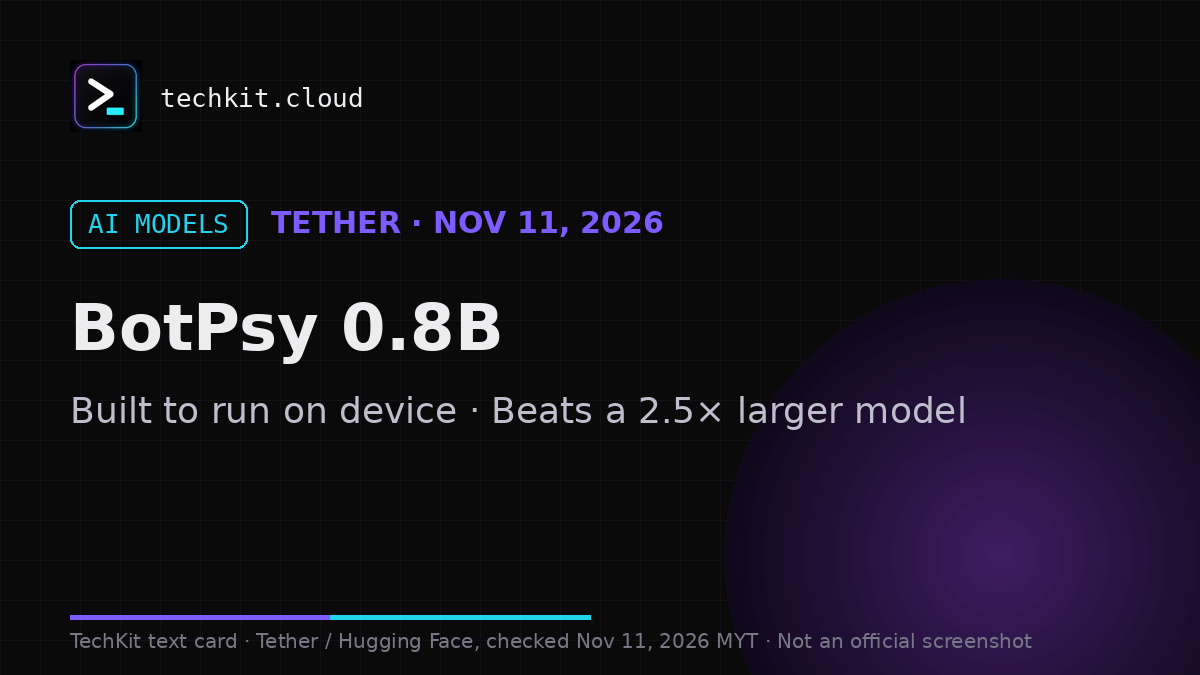
Quick answer: Tether AI Research published BotPsy, a 0.8-billion-parameter model for on-device personal assistants, on the Hugging Face blog on November 11, 2026. Hugging Face lists the publish time as 05:01:16 UTC, which was 13:01 in Malaysia. Tether says BotPsy beats Qwen3.5-2B-Think, a model 2.5 times its size, on five of six tool-use benchmarks, with a BFCL v4 score of 44.0 against 37.7 for the larger model.
What BotPsy is
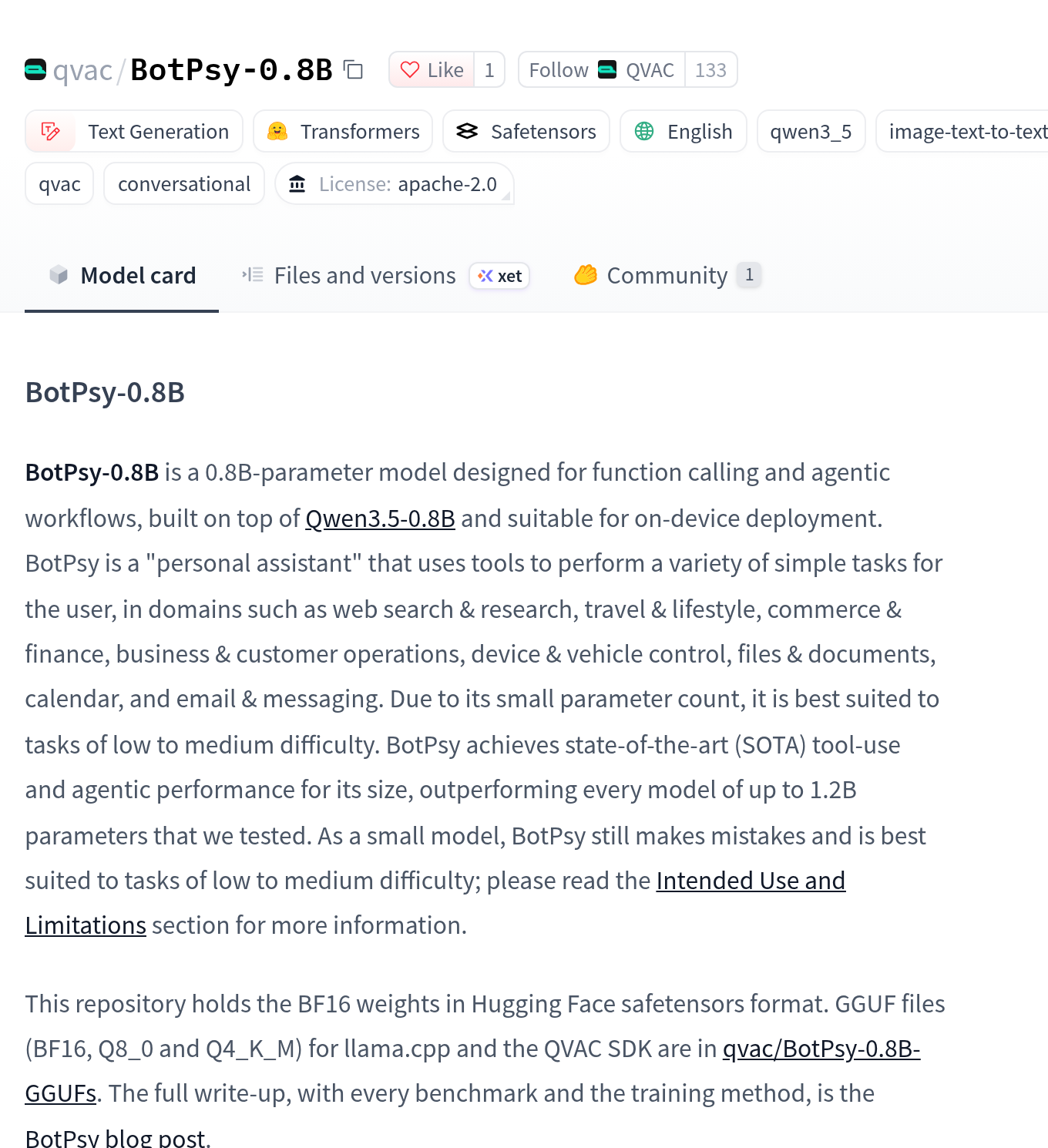
BotPsy is a model built for function calling: choosing a tool and its inputs for a request. Tether built it on Qwen3.5-0.8B, and says it is suitable for on-device deployment, so your data does not have to leave your device to reach a cloud server. Because it has only 0.8 billion parameters, Tether says it is best suited to tasks of low to medium difficulty, and it is not intended for high-stakes use. The model page is qvac/BotPsy-0.8B on Hugging Face, with BF16 weights in safetensors format and GGUF files in qvac/BotPsy-0.8B-GGUFs. The model card lists the Apache 2.0 license, and the weights are already downloadable there. Tether’s blog says the release is for research and educational use.
How it scores
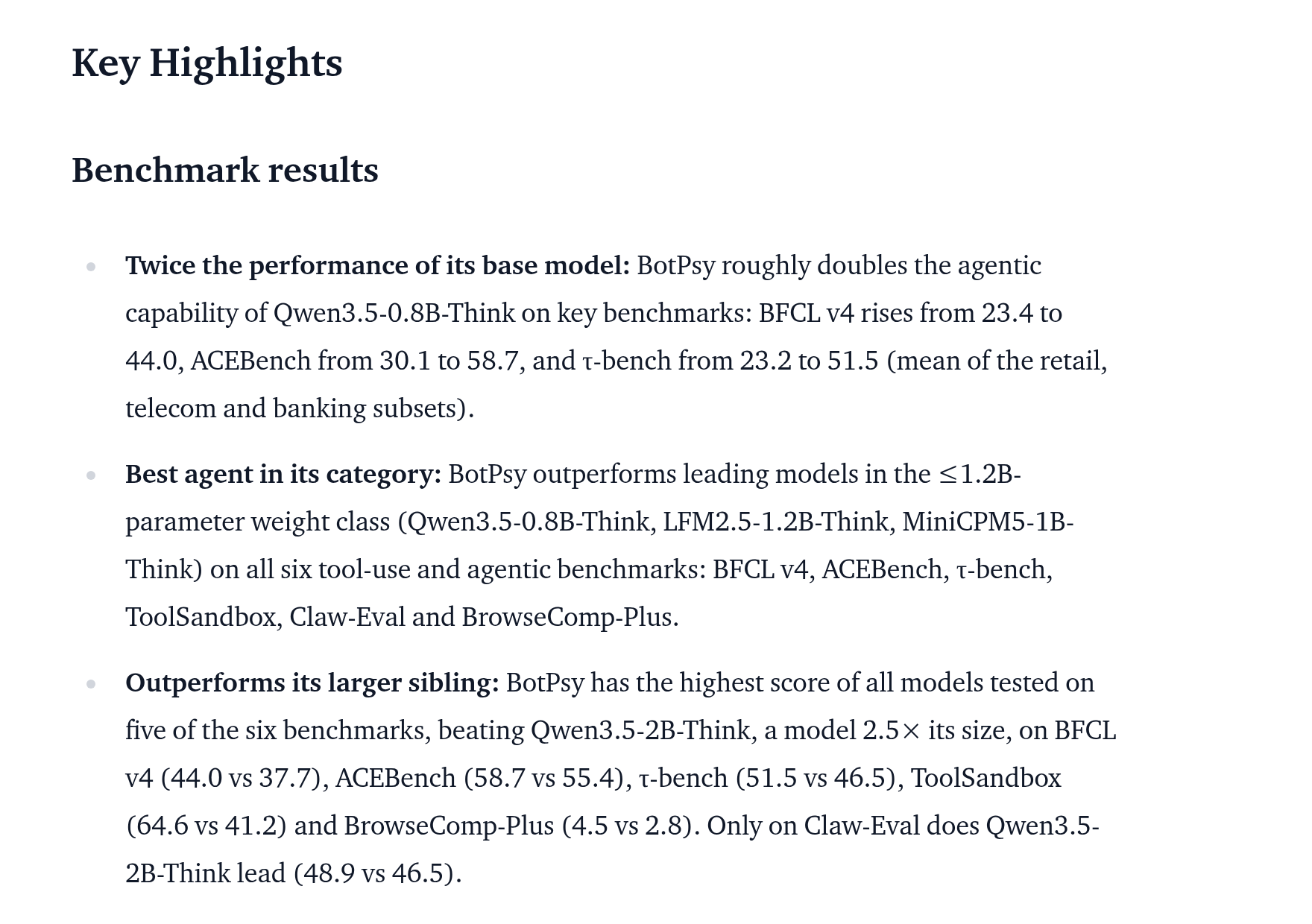
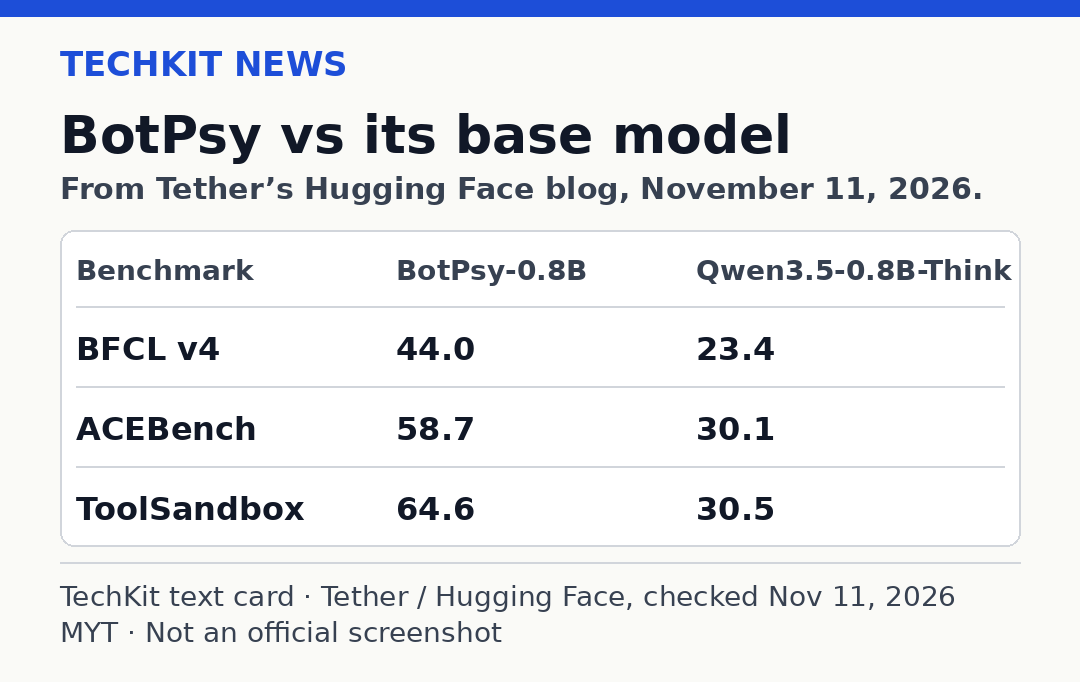
Tether says BotPsy achieves state-of-the-art tool-use performance for its size, outperforming every model of up to 1.2 billion parameters that it tested. It roughly doubles its base model, Qwen3.5-0.8B-Think, on the main tests: BFCL v4 rises from 23.4 to 44.0, ACEBench from 30.1 to 58.7, and ToolSandbox from 30.5 to 64.6. Against the larger model, BotPsy leads on five of six tests, with the exception of Claw-Eval, where Qwen3.5-2B-Think leads 48.9 against 46.5. On τ²-bench telecom, BotPsy scores 82.5 against 69.3 for the larger model.
What it is not good at
General knowledge still scales mainly with parameter count. BotPsy’s GPQA Diamond score is 38.1 and its MMLU-Pro score is 48.9, but Qwen3.5-2B-Think scores 59.9 and 65.5 on those two tests. Tether says BotPsy is therefore designed to call tools for facts it does not know, not to serve as a knowledge model. Open-ended search is the weakest area: its BrowseComp-Plus score of 4.5 is the best of the five models tested, but low in absolute terms. Tether says performance is much lower in Hindi and Russian than in English, which is the recommended language. Safety improves, but the numbers are still high: in Tether’s automated red-teaming, BotPsy produces unsafe responses 21% of the time, against 36% for its base model. Tether says it is not intended for safety-critical decisions, or for applications involving money, personal information, health and other sensitive topics.
How Tether trained it
BotPsy was post-trained in four stages, according to the Hugging Face blog: supervised fine-tuning on tool-use conversations, multi-teacher on-policy distillation, and two rounds of reinforcement learning using DAPO. For distillation, Tether trained three Qwen3.5-4B teachers to specialise in tool use, general reasoning or instruction following. Each prompt goes to one of them, and that teacher gives feedback on every token BotPsy generates. On GPQA Diamond questions that all five models answer correctly, BotPsy uses 3,690 reasoning tokens against 11,563 for its base model.
How to try it
The model card says BotPsy keeps the Qwen3.5 architecture, so Hugging Face Transformers, vLLM and llama.cpp run it without custom code. Turn thinking on, because BotPsy was trained and evaluated in thinking mode, and use temperature 0.3, top_p 0.95, top_k 20 and presence_penalty 1.5. Treat this as a developer release, not a finished phone assistant: there is no app to download, and the intended use is research and education.
For more recent model releases, see our look at K-EXAONE 2.5’s free API and Meta Muse Ember, a $0.10 model for cheap AI agents.
Quick questions
What is BotPsy?
BotPsy is a 0.8-billion-parameter model from Tether AI Research, built on Qwen3.5-0.8B, for function calling and agentic workflows on a device.
Can BotPsy run on a phone?
Tether says it is suitable for on-device deployment and offers GGUF files for llama.cpp and the QVAC SDK. The blog and model card don’t mention a phone app or phone tests, and Tether lists smartphone use under its future plans.
How does BotPsy compare with larger models?
Tether says it beats Qwen3.5-2B-Think, a model 2.5 times its size, on five of six tool-use benchmarks, but trails it on Claw-Eval and by a wide margin on general knowledge tests.
Is BotPsy open source?
The weights are on Hugging Face under the Apache 2.0 license, per the model card, and Tether describes the release as for research and educational use. Training code and training data are not part of this release.
Is BotPsy safe to use for important tasks?
No. Tether says it is not intended for safety-critical decisions, or for applications involving money, personal information, health and other sensitive topics.
Where can I find the model?
See qvac/BotPsy-0.8B on Hugging Face.
Sources
– Hugging Face model card: qvac/BotPsy-0.8B
Last checked: November 11, 2026, 16:35 MYT.