
Disclosure: this article contains no affiliate links. All links are plain links, and we earn nothing if you click them. See our affiliate disclosure.
How this was made: researched and drafted with AI tools from the sources linked in this article, then checked against those sources before publishing.
Quick answer: Google introduced the Gemini Decisions API on November 11, 2026, powered by a new model called Gemini Decision 1. Instead of writing answer text one token at a time, the model scores a list of options in a single pass and returns probabilities and confidence scores. Google says one request can carry up to 1,000 questions, and the price is $0.10 per 1 million input tokens, with no charge for output tokens.
What the Decisions API does
Google describes the API as built for bounded choices, such as tool selection, policy checks, model routing and context grading.
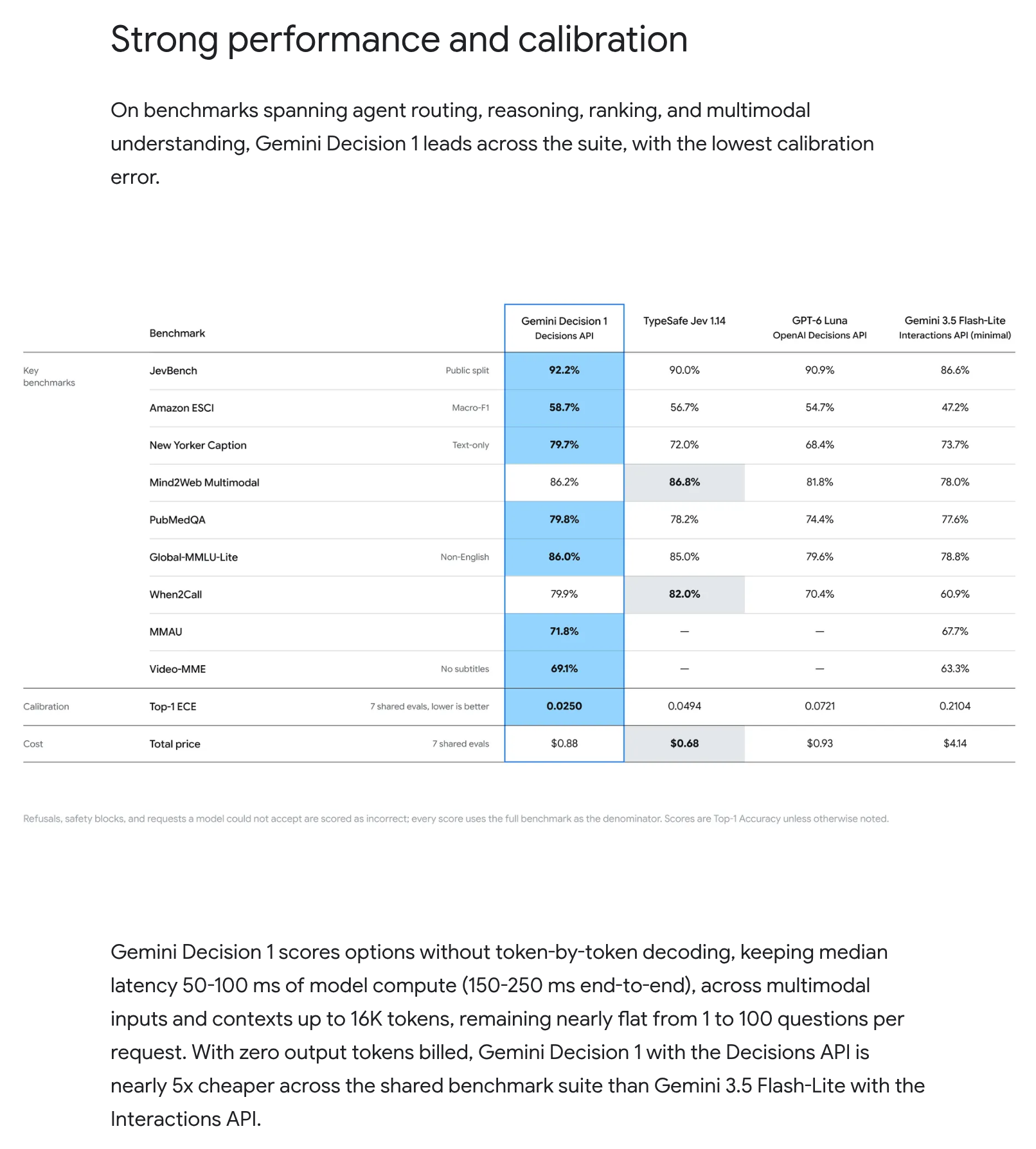
One request takes one multimodal input of up to 256K tokens, across text, images, audio, video and PDFs, along with up to 1,000 independent questions. The API is available now through the Gemini API in Google AI Studio, under the model ID gemini-decision-1, according to Google. Support in Gemini in Google Cloud is coming soon, Google says.
Three question types in one request
A single request can mix three question types, and every answer includes a confidence score from 0 to 1, according to Google. That score lets your code send uncertain cases to a fallback or a human reviewer.
The first type is noul, Google’s name for a yes/no question: it estimates the probability that a yes/no condition holds. The second is choice, or multiple choice: it selects from 2 to 255 choices and returns the winner with normalized probabilities for every candidate. The third is score, or ordered rubric: it grades an input across an ordered rubric starting at 0, returning a continuous weighted score and per-level probabilities.
Google’s example checks a photo of a breakroom counter, together with a short text note, against all three types in one request.
Speed, price and who already uses it
Google puts median latency at 50 to 100 ms of model compute, or 150 to 250 ms end to end, across multimodal inputs and contexts up to 16K tokens. The price is $0.10 per 1 million input tokens and $0 for output tokens. Your shared input is billed once per request, no matter how many questions you evaluate; each question adds only its own instruction and criteria tokens. There is an API no-cost tier in Google AI Studio for prototyping.
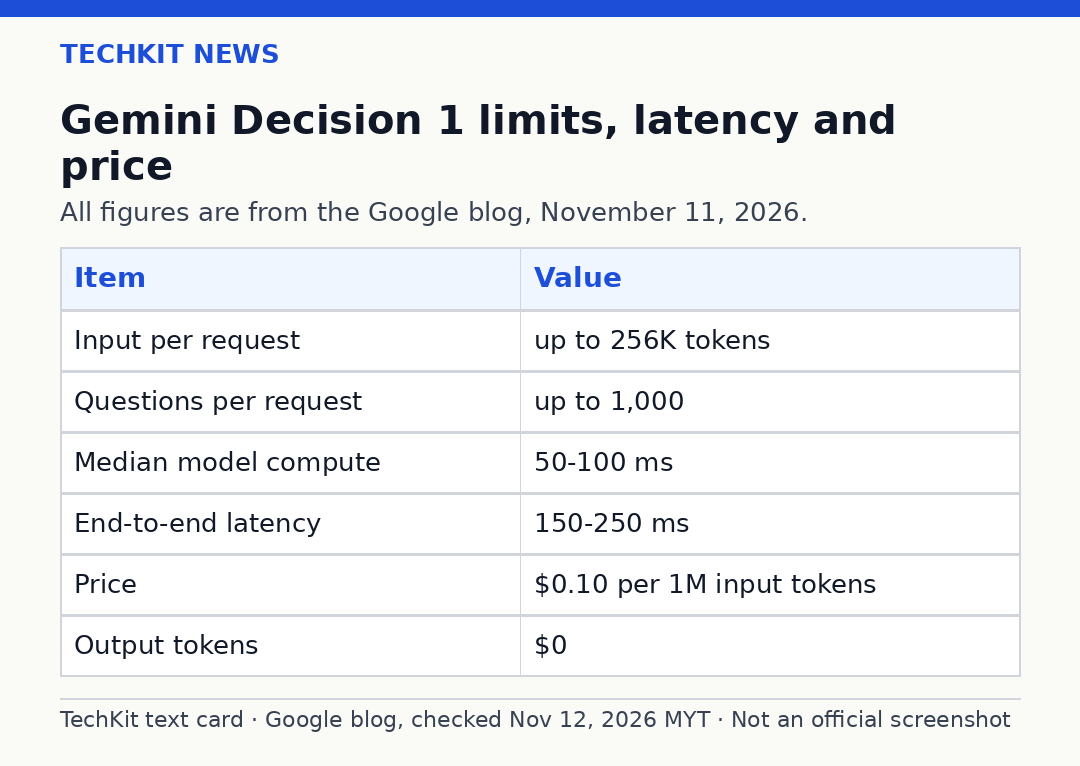
Google says Gemini Decision 1 leads across its benchmark suite, with the lowest calibration error, and that it is nearly 5 times cheaper across that shared benchmark suite than Gemini 3.5 Flash-Lite with the Interactions API. These are Google’s own claims; the blog shows the comparison in chart images, and no independent results are reported.
Google says teams across the company already use the API. Gemini Notebook uses it as a real-time router, serving everyday queries with up to 40% lower latency, according to Google. Integrations are rolling out across OpenRouter, LangChain, Vercel, LiteLLM, Pydantic AI, Pipecat, LiveKit and OpenCode, alongside the google-genai SDKs.
What Google has not said
The blog gives no parameter count, architecture details, training data or model size, and mentions no open weights or licence. Google offers Gemini Decision 1 through its API; the blog does not mention any way to download and run the model yourself. It also gives no list of supported regions and no separate enterprise pricing.
Related on TechKit: Gemini 4 Carbon pricing, November 10 · Gemini in Gmail for Workspace, November 10 · Gemini Intelligence on Pixel 10 and Motorola, November 10
Quick questions
What are the three question types?
Noul for yes/no checks, choice for 2 to 255 options, and score for grading across a rubric starting at 0. Every answer carries a confidence score from 0 to 1.
How much does it cost?
Google lists $0.10 per 1 million input tokens and $0 for output tokens, with the shared input billed once per request. An API no-cost tier is available in Google AI Studio for prototyping.
Can I download the model?
The blog mentions no open weights, download or licence. It describes access through the Gemini API in Google AI Studio only.
Sources
– Google blog, “Gemini Decisions API: Fast, calibrated multimodal decisions”, by Min Choi and Felix Yu (Google DeepMind), November 11, 2026: https://blog.google/innovation-and-ai/technology/developers-tools/gemini-decisions-api/
– Google AI Studio, Decisions API documentation (linked from the blog; checked November 12, 2026): https://aistudio.google.com/docs/decisions-api