
Disclosure: this article contains no affiliate links. All links are plain links, and we earn nothing if you click them. See our affiliate disclosure.
How this was made: researched and drafted with AI tools from the sources linked in this article, then checked against those sources before publishing.
GitHub’s daily Trending pages on November 9 include billion-context, Meta’s Astryx and Anthropic’s Claude Quickstarts. They solve different problems: managing long coding sessions, building interfaces and prototyping Claude applications. Astryx is a design system, not an AI model. Free code doesn’t mean free model usage.
This is a reading-based shortlist, not a hands-on benchmark. Counts below come from our saved November 9 morning snapshot, in Malaysia time. They will change; stars measure attention, not reliability. We have not established why any project’s star count increased.
The three picks at a glance
Data as of Nov 9, 2026, 07:00 MYT.
On a narrow screen, swipe the table sideways to see every column.
| Project | Total stars | Daily gain shown | Main job |
|---|---|---|---|
| billion-context | 5,100 | 460 | Compress long coding-agent conversations |
| Astryx | 16,537 | 863 | Provide React interface components |
| Claude Quickstarts | 19,385 | 28 | Demonstrate Claude API applications |
These are selected entries from GitHub’s daily pages, not a claim that they rank first, second and third across GitHub.
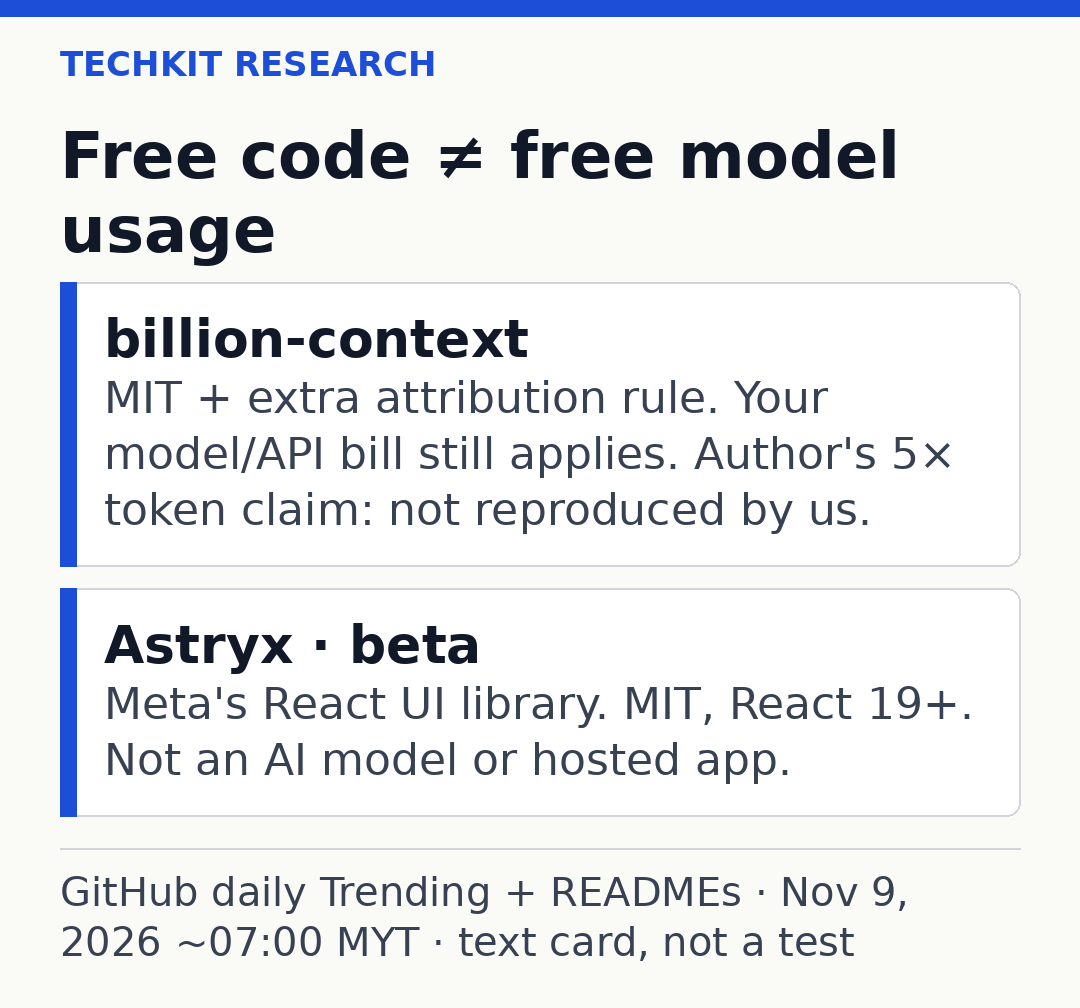
billion-context: compress history, not the price of your model
billion-context sits between a coding agent and its model API. It folds older conversation into summaries and gives the model tools to restore or search compressed material. The aim is to keep a long-running session usable without repeatedly carrying its entire history.

That could help developers who regularly hit context limits. The README’s fivefold token-reduction claim comes from the author; we haven’t reproduced that saving. Compression can lose useful detail; judge it against your own task accuracy and bill, not the headline alone.
Before installing, check two things. Its license is MIT plus an additional attribution requirement: products using it must provide the required credit and repository link. Some client integrations also involve certificate-based interception of model traffic. That’s a security-sensitive change, not a routine chatbot setting. Read the client documentation before considering it, and keep your existing model or subscription costs in the budget.
Astryx: a UI library that AI assistants can work with
Meta’s Astryx is a React design system with more than 150 components, themes and templates. Its documentation is intended for both people and coding assistants, so an assistant has a shared reference instead of inventing a component library.
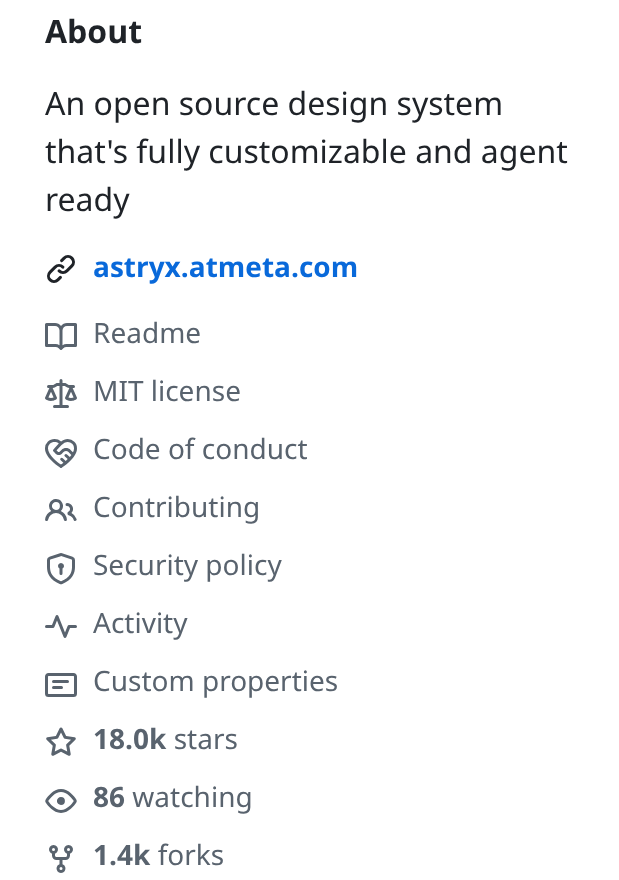
It is MIT-licensed and currently in beta. The README requires React 19 or later and uses StyleX. It’s for developers already building web interfaces, not a hosted AI app a business owner can chat with.
Meta says Astryx grew out of years of internal use. That’s useful background, not an independent accessibility or production-readiness test from us. Check compatibility and try a small interface before migrating an existing product.
Claude Quickstarts: examples, with API costs attached
Claude Quickstarts contains Anthropic’s starter projects for customer support, financial analysis, browser and computer use, and autonomous coding. Its 28-star daily gain is modest; this is an established reference collection, not a sudden breakout.
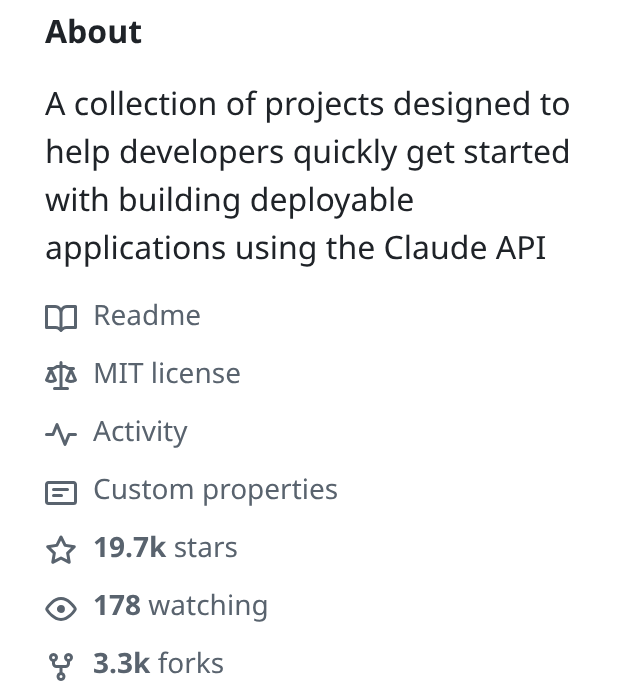
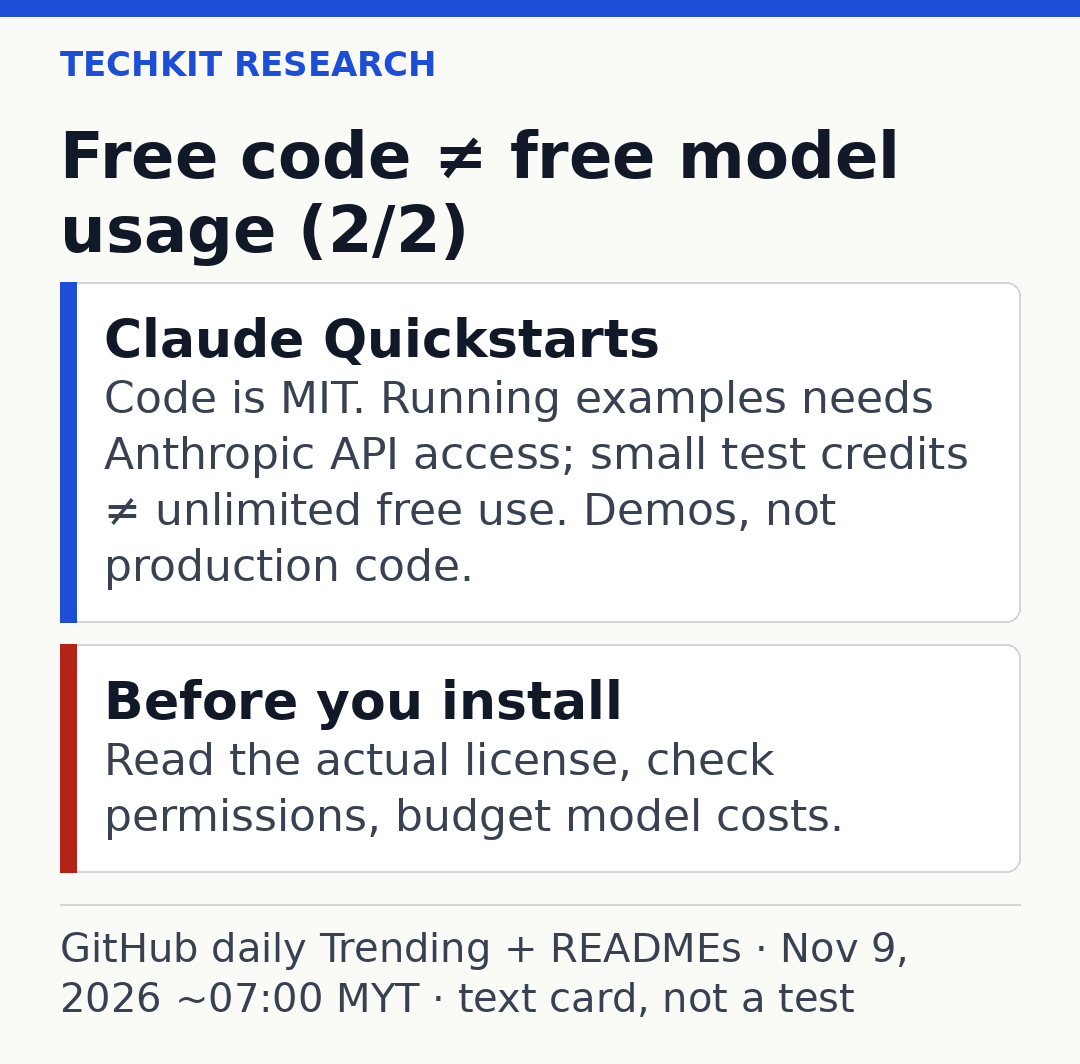
The code is MIT-licensed, but running model-backed examples requires API access. Anthropic’s pricing documentation says new users receive a small amount of testing credits; that is not unlimited free inference. Toolset quickstarts explicitly describe themselves as demonstrations rather than production code. Run desktop-control experiments in an isolated environment.
Which one is relevant to you?
Choose by the problem: conversation growth, interface construction or an application prototype. None removes the need to review permissions, costs and output. For earlier picks, yesterday’s roundup covers OpenMausBot; our November 6 roundup covers agent-browser.
Related on TechKit: GitHub Trending AI repos, Nov 5 · Claude connector chats: what teams can share
Quick questions
Are these all ordinary MIT projects?
No. billion-context adds an attribution term to MIT. Read the actual license rather than relying on a badge.
Is Astryx an AI service?
No. It is a developer interface library that can also be used with AI coding assistants.
Have we tested their performance?
No. This shortlist checks GitHub’s listing and the original project documentation, not runtime results.
Sources: the linked repositories and GitHub’s daily Trending page. Checked November 9, 2026, MYT.
3 thoughts on “GitHub Trending AI Repos Today: November 9, 2026”