
No affiliate links. How this article was prepared: AI helped gather and draft this research; a person checked the facts against the cited sources.
Quick answer: Java4Shell (CVE-2026-114938) is a critical memory-corruption flaw in OpenJDK's Base64 decoder. Specially crafted Base64 input could crash the JVM and allow for unauthenticated remote code execution. Oracle released fixes on November 17, 2026, and CISA strongly urges organizations to patch immediately. The flaw affects OpenJDK 17 from 17.0.6 to 17.0.21 on x86-64 systems with AVX-512 VBMI support.
What Java4Shell is
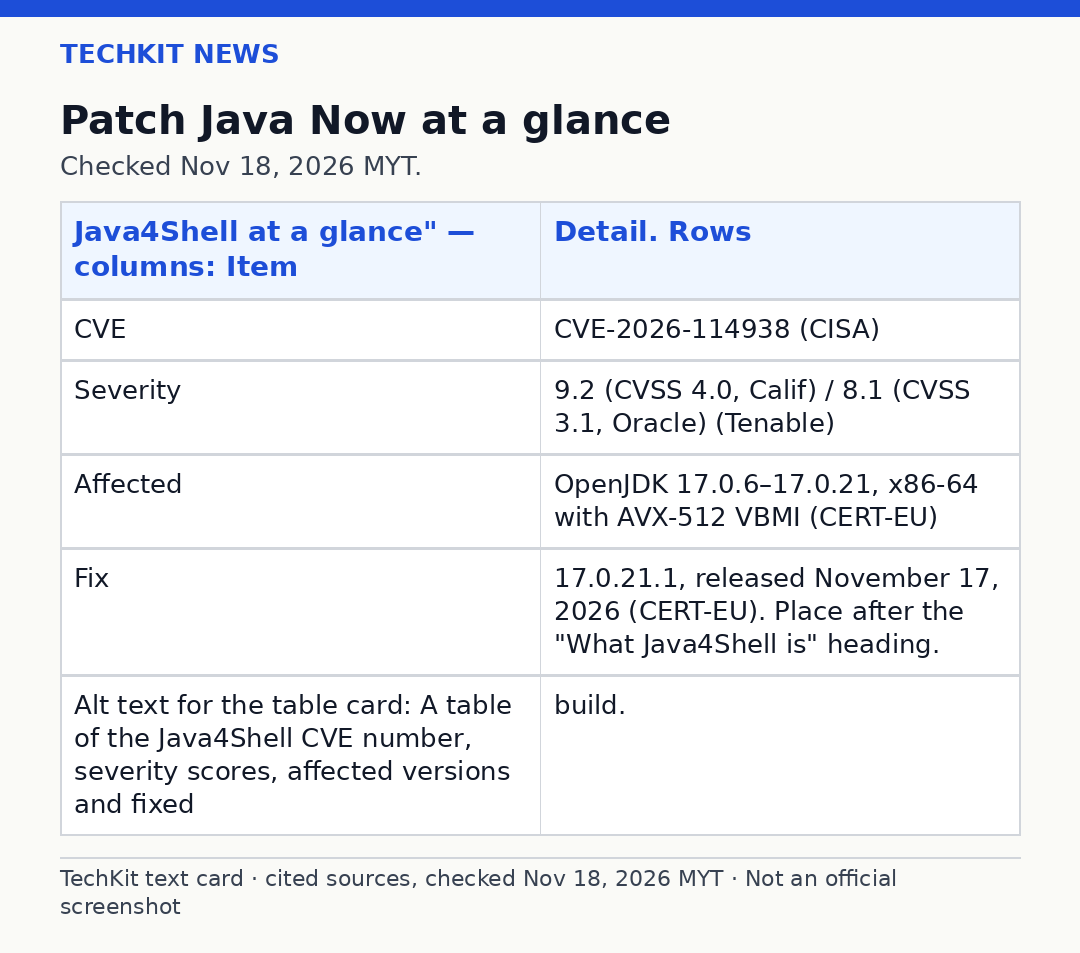
Java4Shell (CVE-2026-114938) is a critical memory-corruption flaw in OpenJDK's Base64 decoder. CISA says the flaw could crash the JVM and allow for unauthenticated remote code execution. CERT-EU says the flaw could lead, under certain circumstances, in unauthenticated remote code execution.
Calif says the corruption can be triggered with just 64 A characters followed by a single =. Oracle assigned it a CVSS 3.1 score of 8.1; Calif says it scores 9.2 under CVSS 4.0.
The affected code runs only on x86-64 processors with AVX-512 VBMI support. On Linux, a system meets the requirement when its processor reports all four of the avx512f, avx512bw, avx512vbmi and bmi2 flags.
Found in an hour with an AI coding assistant
Researcher Quang Luong at Calif discovered the flaw using OpenAI's Codex AI coding assistant. Luong discovered the flaw in approximately one hour and developed an initial working exploit in another two hours. Calif says it burned through just $200 worth of tokens to find Java4Shell.
Each application needs its own exploit. Calif published a proof of concept that triggers the flaw without taking control of the system. Cisco's Talos team has not observed in-the-wild exploitation of the vulnerability yet.
What is affected
The flaw affects OpenJDK 17 from 17.0.6 to 17.0.21; the fix is 17.0.21.1. CERT-EU's advisory lists the affected and fixed builds for the other Java lines.
Unauthenticated attackers can remotely execute code on Jenkins, Atlassian Jira, Confluence and Keycloak.
Patch now, or mitigate
On 17 November 2026, Oracle and the OpenJDK project released fixes for CVE-2026-114938. The November patch update offers 655 patches, 62 of them rated critical, affecting 62 products. CISA strongly urges organizations to immediately patch the recently disclosed Oracle Java vulnerability CVE-2026-114938, and to apply relevant Java and vendor patches as soon as they are available, prioritizing internet-facing systems.
Where immediate patching is not possible, disable the intrinsic feature with -XX:+UnlockDiagnosticVMOptions -XX:-UseBASE64Intrinsics, or disable AVX-512 with -XX:UseAVX=2.
FAQ
What is Java4Shell?
CVE-2026-114938, dubbed Java4Shell, is a memory-corruption flaw in OpenJDK's Base64 decoder. The flaw could crash the JVM and allow for unauthenticated remote code execution.
Am I affected?
The flaw affects OpenJDK 17 from 17.0.6 to 17.0.21, on x86-64 systems where the processor reports the avx512f, avx512bw, avx512vbmi and bmi2 flags.
Which applications are affected?
Unauthenticated attackers can remotely execute code on Jenkins, Atlassian Jira, Confluence and Keycloak. Each application needs its own exploit.
Has it been exploited in the wild?
Cisco's Talos team has not observed in-the-wild exploitation of the vulnerability yet.
Is there a proof of concept?
Yes. Calif published a proof of concept that triggers the flaw without taking control of the system.
How do I fix it?
Apply Oracle's fixed builds, released on 17 November 2026 — for Java 17, the fix is 17.0.21.1 — as soon as they are available, prioritizing internet-facing systems. If you cannot patch yet, disable the intrinsic feature with -XX:+UnlockDiagnosticVMOptions -XX:-UseBASE64Intrinsics, or disable AVX-512 with -XX:UseAVX=2.
Sources
CISA, "Critical Java Vulnerability Requires Immediate Patching" (November 17, 2026): https://www.cisa.gov/news-events/alerts/2026/11/17/critical-java-vulnerability-requires-immediate-patching
CERT-EU, "High Severity Vulnerability in Java SE and OpenJDK" (Security Advisory 2026-021, November 18, 2026): https://cert.europa.eu/publications/security-advisories/2026-021/
Tenable, "Java4Shell (CVE-2026-114938): OpenJDK RCE Vulnerability FAQ" (November 17, 2026): https://www.tenable.com/blog/java4shell-cve-2026-114938-frequently-asked-questions-about-openjdk-rce-vulnerability
BleepingComputer, Lawrence Abrams, "Critical Java4Shell flaw allows RCE attacks on major Java applications" (November 17, 2026): https://www.bleepingcomputer.com/news/security/critical-java4shell-flaw-allows-rce-attacks-on-major-java-applications/
The Register, Simon Sharwood, "Oracle reveals fix-this-ASAP-grade Java4Shell bug that allows attacks on many third-party apps" (November 18, 2026): https://www.theregister.com/security/2026/11/18/oracle-reveals-fix-this-asap-grade-java4shell-bug-that-allows-attacks-on-many-third-party-apps/5310661