
This article contains no affiliate links. How this article was prepared: AI helped gather and draft this research; a person checked the facts against the cited sources.
Quick answer
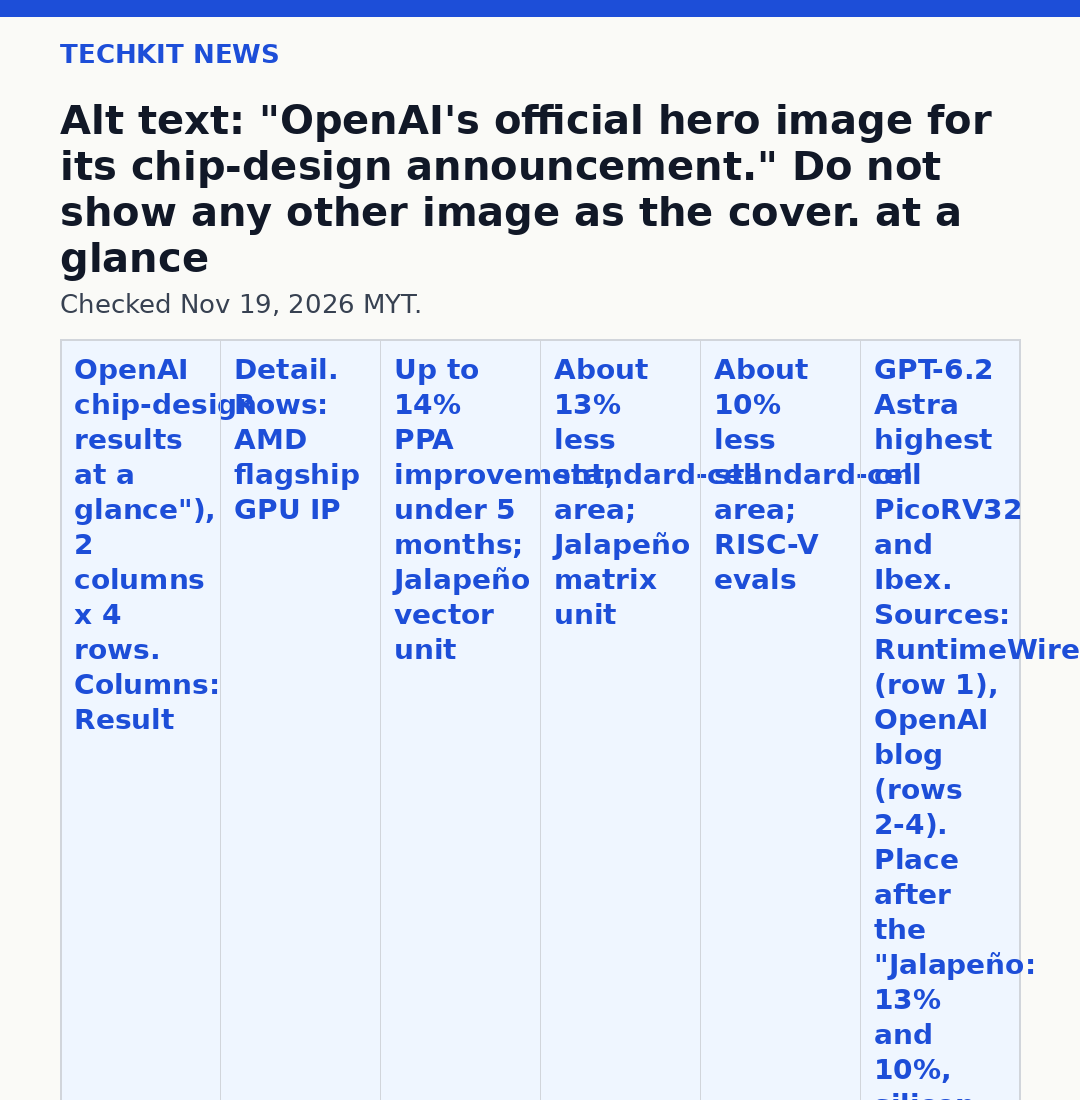
OpenAI says its models found up to 14% improvement in power, performance and area (PPA) on AMD's flagship GPU IP in under five months, against baselines AMD's engineers had already spent years optimizing. AMD has already included some of the changes in a recent design it sent for manufacturing. The same approach cut standard-cell area by about 13% in the vector unit and 10% in the matrix unit of OpenAI's first custom inference chip, Jalapeño, and the gains were silicon proven.
Up to 14% on AMD's flagship GPU
OpenAI said on November 18 that its models identified up to 14% improvement in power, performance and area on AMD flagship GPU IP. The work took less than five months and represented roughly a year of normal progress. The 14% figure is a best case, not an average across the design.
The model identified further improvements by rewriting the code that describes the chip's circuits (SystemVerilog RTL), according to OpenAI's blog post (https://openai.com/index/advancing-chip-design-with-our-models/).
AMD also verified single-digit percentage gains in PPA across key blocks of its upcoming next-generation flagship CPU using designs written by OpenAI's model, according to OpenAI's blog post (https://openai.com/index/advancing-chip-design-with-our-models/).
OpenAI president Greg Brockman said the models helped AMD achieve a year's worth of chip-design improvements in just five months.
Jalapeño: 13% and 10%, silicon proven
The same approach cut standard-cell area by about 13% in the vector unit and 10% in the matrix unit of Jalapeño, OpenAI's first custom inference chip. These optimizations were silicon proven during Jalapeño's silicon bring-up.
RISC-V evals: GPT-6.2 Astra on top
OpenAI tested its models on two open-source 32-bit RISC-V cores, PicoRV32 and Ibex, according to OpenAI's blog post (https://openai.com/index/advancing-chip-design-with-our-models/). With a comparable budget of about 112,000 tokens per run, GPT-6.2 Astra had the highest average score on both cores.
OpenAI notes that designing a core from written requirements lets models omit features found in the original cores, such as performance counters, which may explain part of the score advantage, according to OpenAI's blog post (https://openai.com/index/advancing-chip-design-with-our-models/).
What's next: GPT-Synopsys
OpenAI is partnering with Synopsys to train GPT-Synopsys, a new model, to use Synopsys electronic design automation (EDA) tools the way expert chip designers do.
The partnership was announced on September 30, 2026, when Synopsys and OpenAI signed a multi-year agreement to develop and deliver GPT-Synopsys, a specialized model for chip design. The model is optimized to use Synopsys EDA tools to perform semiconductor design workflows.
FAQ
What did OpenAI claim about AMD's GPU? OpenAI said its models identified up to 14% improvement in power, performance and area on AMD flagship GPU IP, in under five months.
What does PPA mean? Power, performance and area: the three measures of a chip design's efficiency.
What did the models change on Jalapeño? Model-proposed changes reduced standard-cell area by about 13% in the vector unit and 10% in the matrix unit, and the optimizations were silicon proven during Jalapeño's silicon bring-up.
Did AMD use the changes in a real design? AMD has already included some of the changes in a recent design it sent for manufacturing.
Which model led the RISC-V evals? GPT-6.2 Astra had the highest average score on both cores.
What is GPT-Synopsys? A specialized model OpenAI and Synopsys are developing to use Synopsys EDA tools the way expert chip designers do; the two companies announced the partnership on September 30, 2026.
Sources
OpenAI, "Advancing chip design with OpenAI models", November 18, 2026: https://openai.com/index/advancing-chip-design-with-our-models/
RuntimeWire, "OpenAI says its models found up to 14% PPA gains on AMD flagship GPU IP", Ryan Merket, November 18, 2026, 11:20 a.m. CT: https://runtimewire.com/article/openai-says-its-models-found-up-to-14-ppa-gains-on-amd-flagship-gpu-ip
Synopsys, "OpenAI and Synopsys Announce GPT-Synopsys: Frontier Intelligence to Revolutionize Chip Design", September 30, 2026: https://news.synopsys.com/2026-09-30-OpenAI-and-Synopsys-Announce-GPT-Synopsys-Frontier-Intelligence-to-Revolutionize-Chip-Design
OpenAI on X: https://x.com/OpenAI/status/2123100386638877054
Wall St Engine on X (Brockman clip): https://x.com/wallstengine/status/2123073889924473007