
Disclosure: this article contains no affiliate links. All links are plain links, and we earn nothing if you click them. See our affiliate disclosure.
How this was made: researched and drafted with AI tools from the sources linked in this article, then checked against those sources before publishing.
NVIDIA’s Auto Ontology, Claude-Mem and Worktrunk lead this selection from GitHub’s weekly Trending page. Further down are agent skills, game-development workflows, remote coding interfaces and browser tools. Most are additions to an existing developer setup, not complete AI services with free inference included.
This is a documentation-based roundup, not a performance ranking or a hands-on test. It is also not the ten most popular AI repositories across GitHub.
How we selected the ten
We followed GitHub’s weekly Trending page in its displayed order, excluded entries outside our AI-related scope and retained the first ten relevant projects. An astrology engine and the Hyprland desktop compositor were excluded. Scrapling is a borderline inclusion: a scraping framework with integrations for AI agents, rather than an AI model itself.
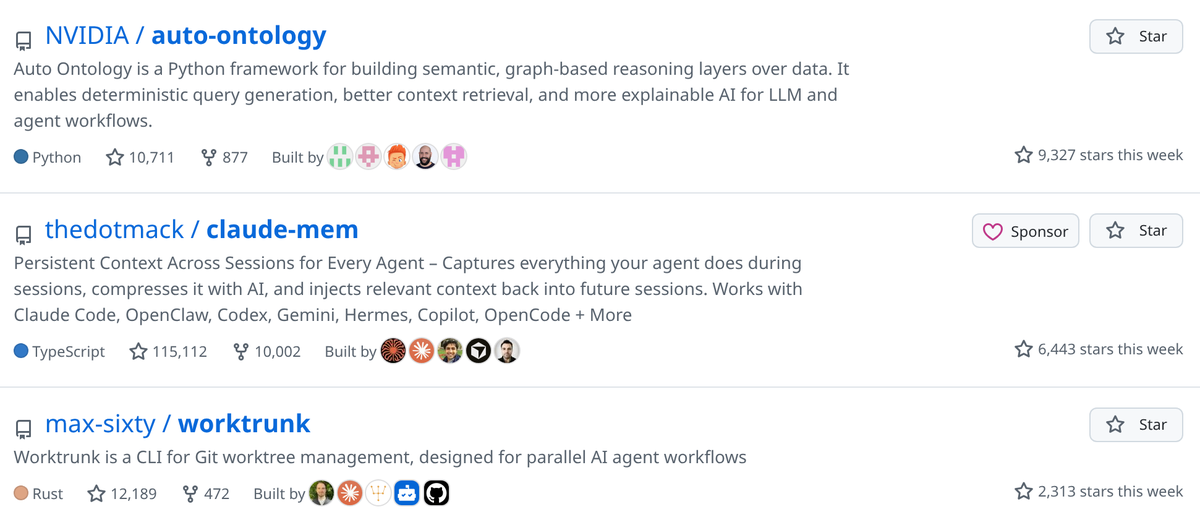
As shown in the screenshot, 17:31 MYT:
| Repository | Stars this week |
|---|---|
| NVIDIA/auto-ontology | 9,327 |
| thedotmack/claude-mem | 6,443 |
| max-sixty/worktrunk | 2,313 |
The table preserves that filtered order; it is not sorted by weekly gains. Counts come from our saved November 9 morning snapshot, MYT. GitHub’s displayed gains are not adoption figures, and these totals will move after publication. We did not verify the reasons for any increase.
Data as of Nov 9, 2026, 07:00 MYT.
On a narrow screen, swipe the table sideways to see every column.
| Order in this selection | Project | Total stars | Gain shown this week |
|---|---|---|---|
| 1 | NVIDIA/auto-ontology | 10,338 | 9,044 |
| 2 | thedotmack/claude-mem | 114,878 | 7,482 |
| 3 | max-sixty/worktrunk | 12,109 | 2,292 |
| 4 | anthropics/skills | 189,570 | 2,796 |
| 5 | Donchitos/Claude-Code-Game-Studios | 36,974 | 5,719 |
| 6 | milind-soni/OpenMausBot | 18,169 | 7,077 |
| 7 | pingdotgg/t3code | 52,430 | 17,100 |
| 8 | Nutlope/hallmark | 50,920 | 6,624 |
| 9 | D4Vinci/Scrapling | 99,839 | 8,712 |
| 10 | vercel-labs/agent-browser | 47,540 | 1,476 |
What each project is for
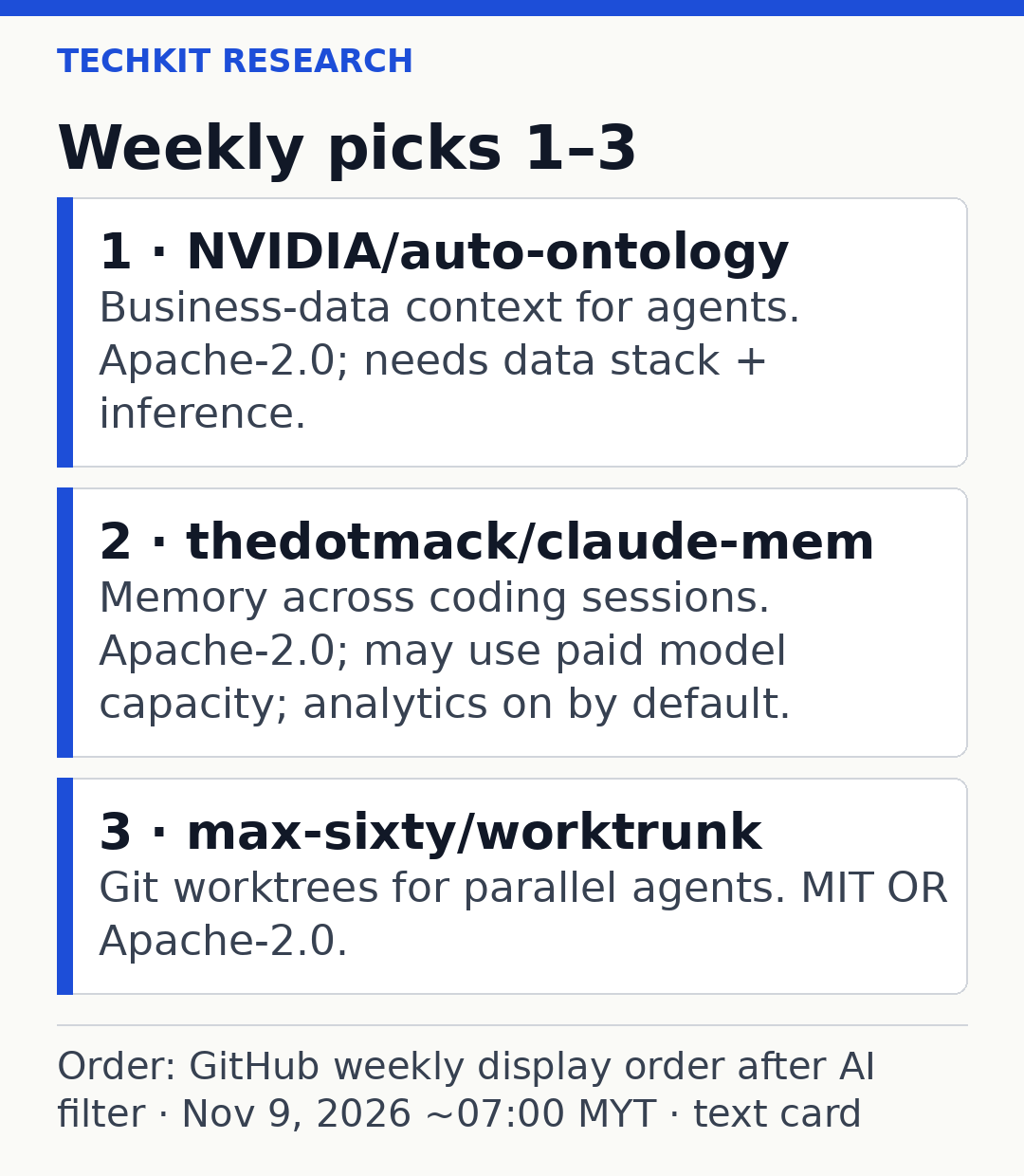
1. Auto Ontology: give business data shared definitions
NVIDIA’s Auto Ontology builds a context layer from enterprise metadata so an agent can understand what a metric means and where it came from. It exposes that context through MCP, a command-line interface and an API.
This is for data teams, not someone looking for a spreadsheet chatbot with no setup. The Apache-2.0 code still needs a data stack and inference infrastructure; the README uses NVIDIA NIM endpoints. NVIDIA also says the project is not currently accepting external contributions. None of that establishes accuracy on your company’s definitions without evaluation.
2. Claude-Mem: carry observations between coding sessions
Claude-Mem runs a second agent that records observations while a coding agent works. A later session starts with a compact memory index and retrieves details as needed.
Its software is Apache-2.0, but the memory provider matters. The README describes an optional hosted observer trial, your own OpenRouter or Gemini key, or your Anthropic plan. Memory can use paid model capacity too. It says local storage is used, cloud sync is opt-in and anonymous usage analytics are on by default. Review those choices before putting sensitive project history into it.
3. Worktrunk: separate parallel changes with worktrees
Worktrunk makes Git worktrees easier to manage when several coding agents work in parallel. Each agent can have a separate working directory rather than modifying the same checkout.
The actual license offers MIT or Apache-2.0 at your choice. An ambiguous license label in a repository index doesn’t make it non-standard or proprietary. Worktrunk does not provide the agents or their model allowance, and separated directories do not remove the need to review and merge changes carefully.
4. Anthropic Skills: reusable task instructions
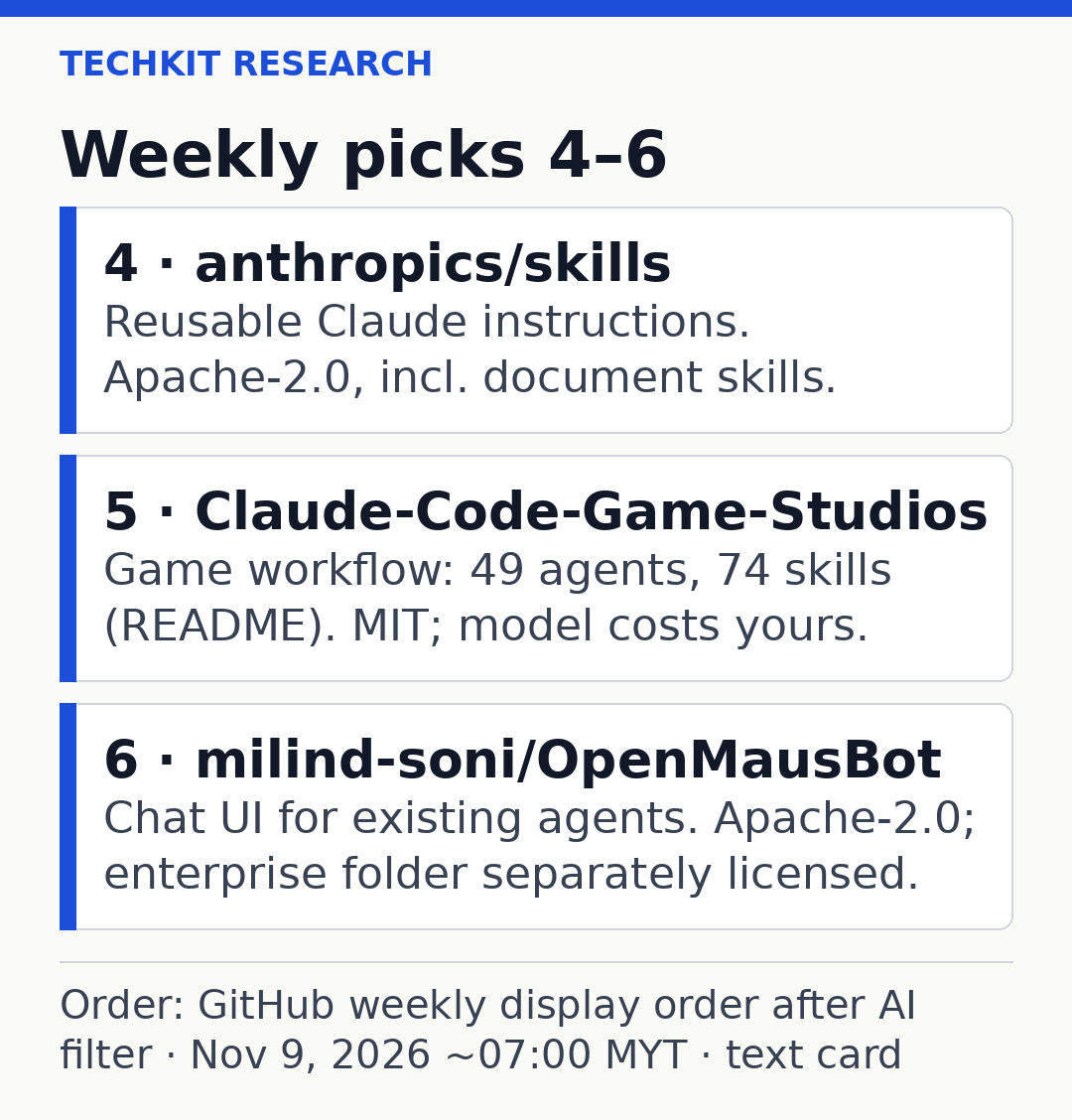
Anthropic’s skills repository contains task-specific instructions and supporting resources that Claude can load. It’s useful for learning to package a repeatable workflow instead of rewriting the same prompt each time.
The current README says the skills are Apache-2.0, including its document skills; we also checked the DOCX skill’s Apache-2.0 license file. Don’t repeat older descriptions of those document examples as restricted source-available material. They aren’t current fact. Access to a skill still does not include a Claude subscription or guarantee that its output is correct.
5. Claude Code Game Studios: organize a game project
Claude Code Game Studios provides an MIT-licensed workflow with 49 agents and 74 skills, according to the README. Roles span design, programming, art, audio, narrative and testing.
That can help a solo developer organize work. A role list doesn’t prove you’ll get a finished, enjoyable game. Its own documentation distinguishes executing and testing a game from merely producing plans. The Claude Code or model costs remain yours. Start with a small playable task and check the result before adopting the full workflow.
6. OpenMausBot: a chat interface for existing agents
OpenMausBot presents agents as contacts in a chat application and uses existing local AI command-line tools and accounts. We covered it in the November 8 daily roundup.
The open-source edition is Apache-2.0; the enterprise folder has its own license. The interface doesn’t make existing provider usage free. The README also says optional Boat cloud computers are paid after their trial, and third-party services have their own terms. Compare the local-only setup with the integrations you actually need, not every optional feature at once.
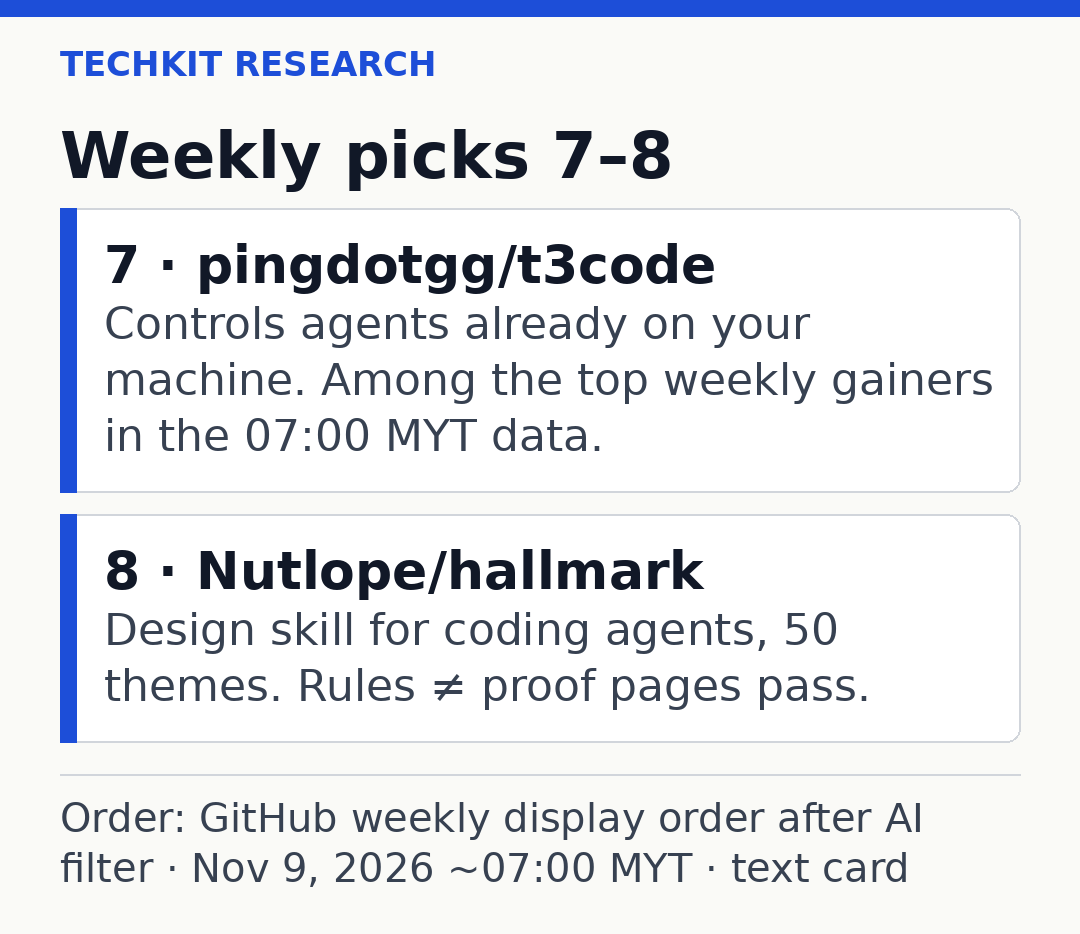
7. T3 Code: control agents from another interface
T3 Code describes itself as an “agent harness control surface.” Its web, desktop and mobile interfaces control agents already installed and authenticated on your computer.
It is not a new model or a bundle of provider subscriptions. The README lists support for tools including Claude Code, Codex, Cursor, Grok Build, OpenCode and Antigravity. Based on the 07:00 MYT data, T3 Code, at 17,100, was among the top weekly gainers in this selection; that says nothing about every repository on GitHub. Check remote-access settings before exposing a working development machine.
8. Hallmark: give generated websites design constraints
Hallmark is a design skill for coding agents, with fifty themes and workflows for redesign and audits. Its documentation describes checks for contrast, focus, reduced motion, invented facts and broken phone layouts.
Those are sensible checks, but stating a rule doesn’t prove every generated page passes it. You still need your real content, an agent to do the work and a browser check of the final page. It’s most relevant if your existing coding assistant produces repetitive-looking interfaces.
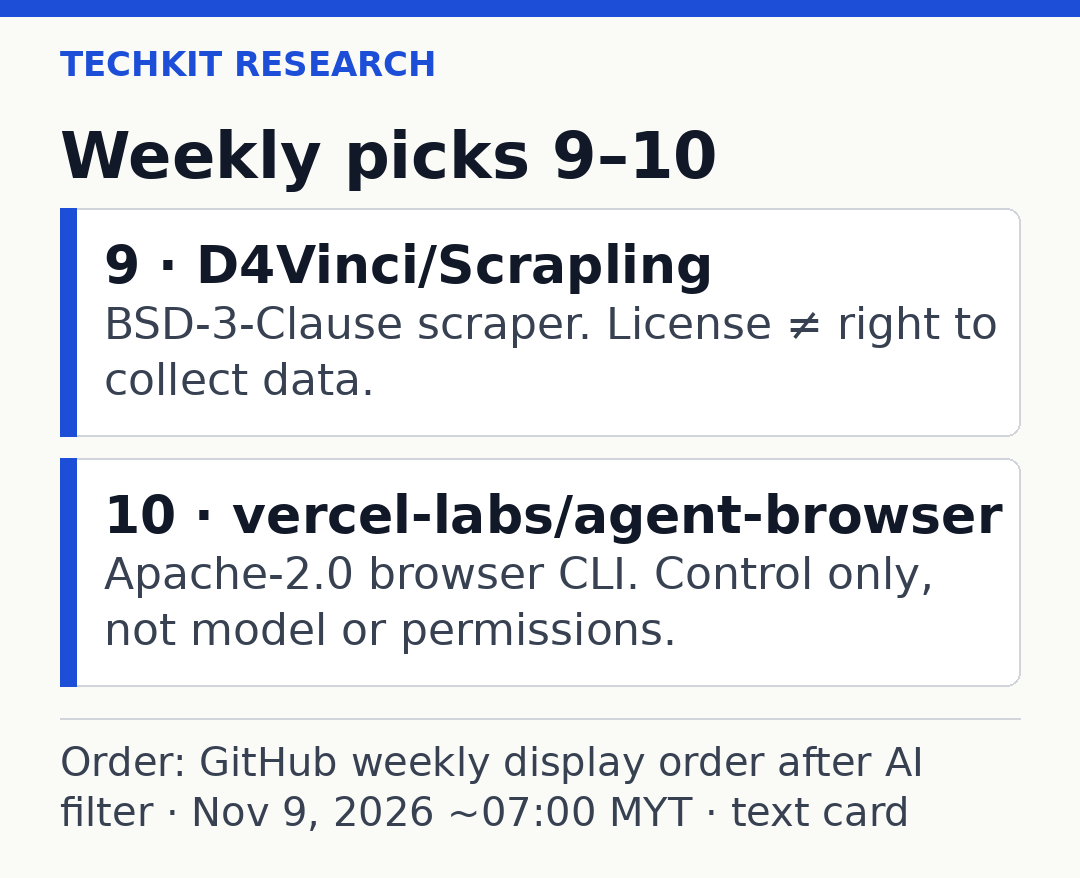
9. Scrapling: collect web data for an agent workflow
Scrapling is a BSD-3-Clause Python scraping and crawling framework. MCP and Agent Skill integrations explain its inclusion here, but its core job is fetching and extracting web content.
The software license doesn’t grant rights to collect or republish a site’s data. Check permission, privacy obligations and rate limits, and stop at access restrictions rather than treating them as an invitation to evade controls. Infrastructure and any third-party services are separate from the free library.
10. agent-browser: let an agent operate a browser
Vercel Labs’ agent-browser is an Apache-2.0 browser automation command-line tool. It presents page content as an accessibility tree with references an agent can act on.
It supplies browser control, not the reasoning model, account access or permission to submit consequential actions. Use a test environment and supervise changes to real accounts. For earlier coverage, see our November 6 roundup.
What the list suggests—and what it does not
This selection leans heavily toward the practical layers around coding agents: memory, parallel working directories, instructions, interfaces and browser control. That is an observation about these entries, not proof of why developers starred them or that any one approach has won.
For a non-developer, most are not drop-in productivity apps. Installation, credentials, model billing and testing remain part of the work. Choose one concrete task and one tool to evaluate before assembling a larger system.
Related on TechKit: GitHub Trending AI repos, Nov 5 · Claude connector chats: what teams can share
Quick questions
Which gained the most stars this week?
Based on the 07:00 MYT data, T3 Code was among the top weekly gainers of our ten picks, using GitHub’s displayed weekly figures.
Does free software mean free operation?
No. Model usage, hosting and optional services can be billed separately.
Can I trust the star count as a quality score?
No. Read the original documentation, review permissions and test the behavior you need.
Sources: the ten linked original repositories, their current documentation and GitHub’s weekly Trending snapshot. Checked November 9, 2026, MYT.